In 1992 it was a known fact about this scam. Today it has multiplied to an astronomical number. At first it did not seem to be much. Now it is huge.
Millions of acres are being purchased from private enterprise by the feds, states, counties and the sly Non-Governmental Organizations, (NGO). Data shows cattle numbers are the least since 1958, but keep in mind land has been acquired from ranchers and private owners taking it out of cattle production. Up to 45% of the US land mass is owned by non tax paying manipulators who are sucking the land asset away from agriculture. The land for cattle production is fast reducing and these land buyers are a huge enemy to agriculture.
NGOs which have a charter of protecting the lands for bike trails, spotted owls, etc., mostly get funded from *government grants. The mass deception is–“non-government” appears on the surface to be non government, but in fact with every government grant there are regulations with the grant to do certain picayune uses, mostly never evaluated by funders for validity. As a result most grants are poorly managed scams–in this case against agriculture. In fact “non-government” is another word for government. NGOs do not pay property tax.
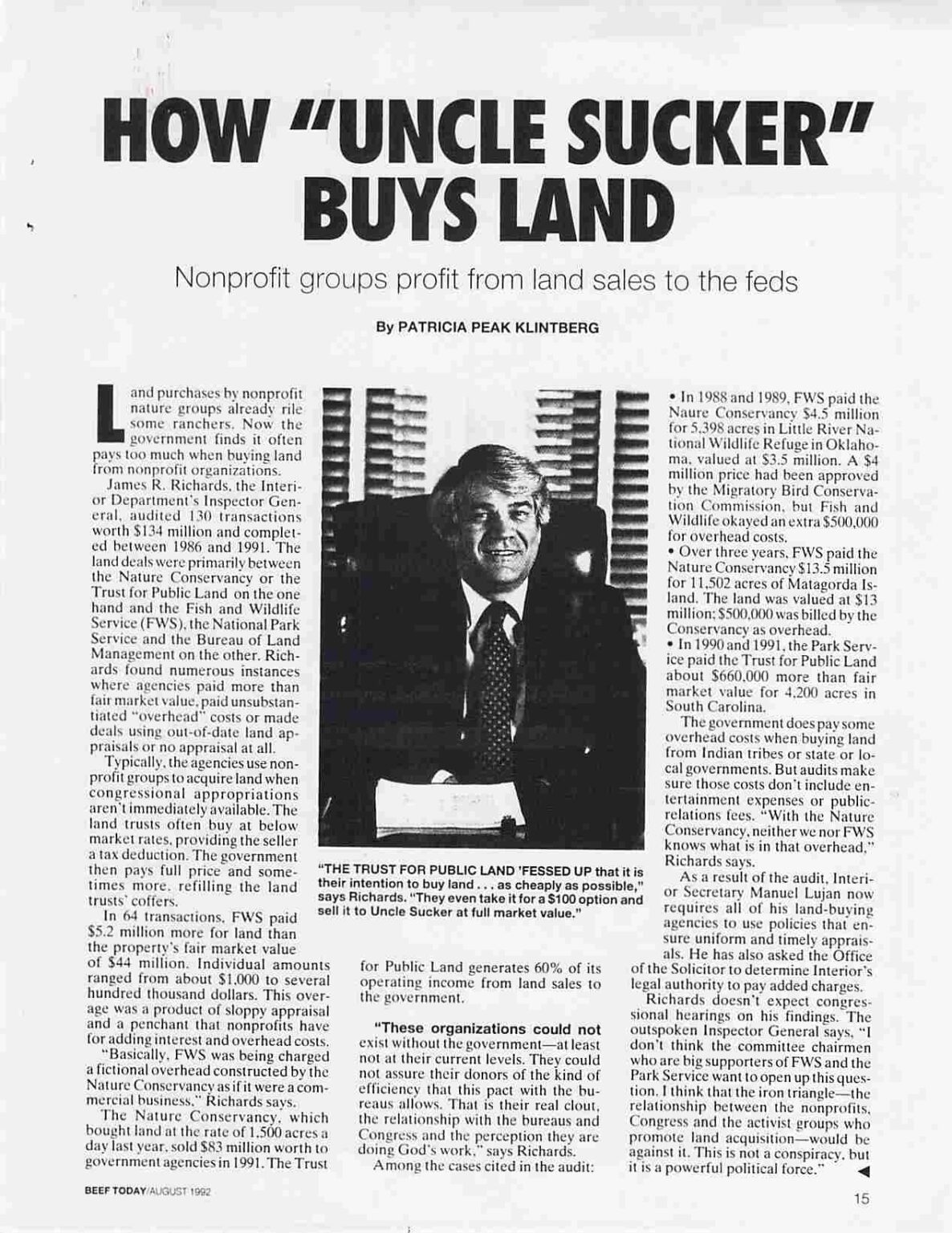
Attached are 3 articles with data. One from Beef Today, 1992, and two I researched over a year ago. The data is easy to understand. Although it is not Somali Pirates robbing agriculture, yet the fellow you sit
beside at a PTA meeting may be living fraudulently on grants–your neighbor.
*Grants are a parallel to communism. Grants are taken from the successful and given to people who could not get any normal funding for love nor money.
Posts Tagged Totalitarian Government
NGO scams and grants
Jan 10

No, Mike Lee isn’t paving over Yellowstone for condos
June 20, 2025
The left’s idea of stewardship involves bulldozing bison and barring access. Lee’s vision puts conservation back in the hands of the people.
The media wants you to believe that Sen. Mike Lee (R-Utah) is trying to bulldoze Yellowstone and turn national parks into strip malls — that he’s calling for a reckless fire sale of America’s natural beauty to line developers’ pockets. That narrative is dishonest. It’s fearmongering, and, by the way, it’s wrong.
Here’s what’s really happening.
Private stewardship works. It’s local. It’s accountable. It’s incentivized.
The federal government currently owns 640 million acres of land — nearly 28% of all land in the United States. To put that into perspective, that’s more territory than France, Germany, Poland, and the United Kingdom combined.
Most of this land is west of the Mississippi River. That’s not a coincidence. In the American West, federal ownership isn’t just a bureaucratic technicality — it’s a stranglehold. States are suffocated. Locals are treated as tenants. Opportunities are choked off.
Meanwhile, people living east of the Mississippi — in places like Kentucky, Georgia, Ohio or Pennsylvania — might not even realize how little land their own states truly control compared to federally owned. But the same policies that are plaguing the West could come for them next.
By: Leo Wolfson – January 20, 2025

One of the most popular political topics in Wyoming is private property rights and how far, or not, they should extend.
On Monday, that topic took center stage in the Wyoming House over a discussion on a bill that would require the sale of all private property to the federal government in Wyoming be matched with a corresponding decrease in federal land.
House Bill 118 would mark a significant change for those wanting to sell their land for recreation or other purposes to the federal government, and likely limit most of these transactions moving forward.
The crux of Monday’s debate came down to whether it’s most important to prioritize blocking growth of federal government land or retaining private property owners’ rights to sell their land to the government as they desire. Blocking the growth of federal land won out, which is the main purpose of HB 118.
The bill sponsor, Rep. Dalton Banks, R-Cowley, said just because federal land transfers have been accepted throughout Wyoming’s statehood doesn’t make it right. He also said his bill protects property owners from federal overreach and sweeping government mandates.
“We’re not limiting who you can sell to, we are limiting the federal government under our Constitutional responsibility by our act of admission that we’re limiting their right to purchase,” Banks said.
The House rejected by a 34-25 vote Monday an amendment brought by Rep. Karlee Provenza, D-Laramie, that would have removed the private property owners’ aspect of the bill while retaining the ban on selling state land without a corresponding trade-off with federal land.
“This limits just compensation,” Provenza said. “This means that, potentially, the greatest buyer who wants to spend their money here can’t buy that property from that private property owner.”
The bill advanced on second reading and will be considered one more time before it’s sent to the Senate.
Stopping Federal Growth vs. Private Property
There have been a few private and state land sales in Wyoming over the last few years that have drawn criticism from some for adding to the acreage that the federal government owns.
The most recent example is the Kelly Parcel that was finalized at the end of last year, which conveyed 640 acres of pristine state land in Teton County to the National Park Service for $100 million for the land to be incorporated into Grand Teton National Park.
Another prime example was the 2023 sale of the 35,670-acre Marton Ranch in Natrona County, private property that was sold for $21 million to the BLM.
“Those people that sold that — it’s their land, it’s their right,” Rep. Steve Harshman, R-Casper, said of the Marton sale. “To infringe on private property rights, it gives me pause.”
Jess Johnson, government affairs director for the Wyoming Wildlife Federation, told Cowboy State Daily the Marton sale was critical in providing continuous public hunting and fishing access. She said other land transfers can be beneficial for agricultural interests by preventing land from being sold to make residential subdivisions.
She also pointed out that her organization supported the Marton Ranch sale being opened up to a public comment period even though they already supported the sale. This happened after the state of Wyoming filed an appeal of the sale, which required the agency to seek public comment and complete an additional environmental review.
“Because the process matters,” Johnson explained. “That is there as a stopgap. It’s not willy-nilly sales. There are approval steps the government has to go through.”
Babysitting Or State Sovereignty?
Rep. Tony Locke, R-Casper, said he sees the issue as a matter of protecting Wyoming’s sovereignty as a state. Rep. Tom Kelly, R-Sheridan, agreed, saying that nothing precludes the federal government from pressuring private landowners to sell their land.
Rep. Mike Yin, D-Jackson, disagreed and compared the bill to “babysitting” on part of the state government, while Rep. Cody Wylie, R-Rock Springs, described it as “a cloth we don’t need to be cutting.”
Others who spoke in support of Provenza’s amendment expressed a desire for private property owners to have the final say in what happens to their land rather than the federal government.
“I believe every individual has the right to develop his potential, to use and enjoy his own property, tangible or intellectual, and pursue his own interests, free from restrictions or arbitrary force,” said Rep. J.T. Larson, R-Rock Springs.
Rhetoric against the federal government was sharp Monday from those who support Banks’ bill, with some going as far as comparing the government to an adversarial foreign nation.
“We could have a real debate about adversarial, and I think the federal government could definitely be linked in there,” said Rep. Reuben Tarver, R-Gillette.
Rep. Rob Geringer, R-Cheyenne, brought up the example of a piece of contaminated land owned by the city of Cheyenne west of the city that neighboring private landowners have been unable to get help in cleaning up from various public entities.
“I could see selling it to the federal government to help with,” Geringer said.
Rep. John Bear, R-Gillette, pointed out that for any purchase made by the federal government, the money comes from taxpayers.
“Actually taking opportunity away from private citizens who paid into the government’s coffers,” he said. “If you want to protect private citizen’s ability to make these types of transactions, we should limit the ability of the federal government to come in and to make these purchases.”
Constitutional Arguments
Both the Wyoming and U.S. constitutions state that private property shall not be taken or damaged for public or private use without just compensation. The U.S. Supreme Court has also said that property rights are necessary to preserve freedom by allowing property owners to plan their destiny on an individual basis.
“You have said here this morning, members, some of you have argued that the government knows better on who you should sell your land to,” Provenza said. “That’s a dangerous slippery slope isn’t it? The government knows better. I argue the government doesn’t know better here.”
But under the Wyoming Acts of Admission when it gained statehood, Wyoming was “admitted into the union on an equal footing with the original states in all respects whatever; and that the Constitution which the people of Wyoming have formed for themselves be, and the same is hereby, accepted, ratified and confirmed.”
“This is the ability of the state of Wyoming to have jurisdiction over all the lands within our borders,” Banks said.
The U.S. Constitution also limits what types of property the federal government can purchase, which Rep. Ken Pedergraft, R-Sheridan, believes it has far exceeded.
“At some point we the people need to stand up,” he said. “Yes, you are a private citizen, you can sell to whomever you want, but the federal government doesn’t have the right to buy any more land.”
Leo Wolfson can be reached at leo@cowboystatedaily.com.
In 2024, Utah filed a lawsuit challenging the federal government’s control over 18.5 million acres of “unappropriated” land—areas without specific congressional designations like national parks or forests. The state contends that the indefinite federal retention of these lands is unconstitutional, arguing that the Property Clause of the U.S. Constitution grants Congress the power to “dispose of” federal lands, not to hold them without designated use.
Utah Attorney General Sean Reyes emphasizes that federal control over nearly 70% of Utah’s land limits the state’s sovereignty and self-governance. The lawsuit also challenges the Bureau of Land Management’s (BLM) recent Public Lands Rule, which elevates conservation to a status equal with grazing and mineral development. Utah argues this shift contradicts the BLM’s legal obligation to promote multiple-use and sustained yield under the Federal Land Policy and Management Act (FLPMA).
The case has garnered support from various states, counties, and organizations, all urging the Supreme Court to hear it. Critics of federal land retention assert that it infringes on state sovereignty and hampers economic activities such as grazing, energy production, and recreation. They also claim that policies mandating indefinite federal land retention treat states like Utah unequally compared to those with greater control over their lands.
This legal challenge underscores ongoing tensions between state and federal authorities over land management in the Western United States, with significant implications for public land policy and state sovereignty.
Full Article here: https://americanstewards.us/utah-fights-for-control-of-federal-lands/

The State of Utah has a website called Stand for our Land at https://standforourland.utah.gov/
Memo: As world food needs project up to an increase of 98% by 2050 the Biden-Harris administration is Hell-bent on acquiring (with tax funds) 30% of the US land-mass by 2030 and then 50% by 2050. The purpose stated for purchasing private lands and placing them into government ownership is for “protection.” Protection means to remove these lands from oil production, farming, ranching and all private enterprise profitable uses. No more food can be produced on protected lands.
The following article from American Stewards of Liberty provides the history, funding and sinister motives of this, the largest land-grab in American history. Take a long cold look at what this removal of productive lands does to future food production. Many believe this is totally to force citizens to turn to government for all foods. D
Where is Kamala Harris on the 30×30 Agenda?
by ASL Admin | Aug 1, 2024 | 30×30, Issues, Liberty Matters

The new Democrat nominee for President, Kamala Harris was one of the earliest advocates of the 30×30 agenda, long before most Americans had been made aware of the international land grab.
When Kamala Harris was in the U.S. Senate, she, along with 12 other liberal senators filed S. Res. 372, “[a] resolution expressing the sense of the Senate that the Federal Government should establish a national goal of conserving at least 30 percent of the land and ocean of the United States by 2030.”
Harris, along with liberal Senators Cory Booker, Dianne Feinstein, Elizabeth Warren and Bernie Sanders filed the resolution on October 22, 2019, two years prior to Biden’s Executive Order 14008 that launched the 30×30 land grab in America.
Section 5(E) of the resolution reads: “at the current rate of losses, less than 10 percent of the Earth will be free of substantial human impact by 2050,” reinforcing that a potential Harris Administration will continue Biden’s destruction of our nation’s private property and the livelihoods of millions of American landowners.
In addition, then U.S. Rep. Debra Haaland from New Mexico, now our current Department of Interior Secretary, sponsored and filed the companion resolution in the U.S. House, H. Res. 835, expressing the exact same desire of protecting 30 percent of our land and ocean by 2030. She had 42 co-sponsors in the House.
If elected president, Kamala Harris will continue with Biden’s plan to carry out what Karl Marx first imagined in his “Communist Manifesto,” the “abolition of private property.” They wish to destroy capitalism and as Barak Obama said “…fundamentally transform[ing] the United States of America.”
To implement socialism in America they must gain control of our land, and therefore our liberty — the clear intent of 30×30.
You can dig deeper into the 30×30 agenda and learn more about who is behind this agenda on our 30×30 webpage.
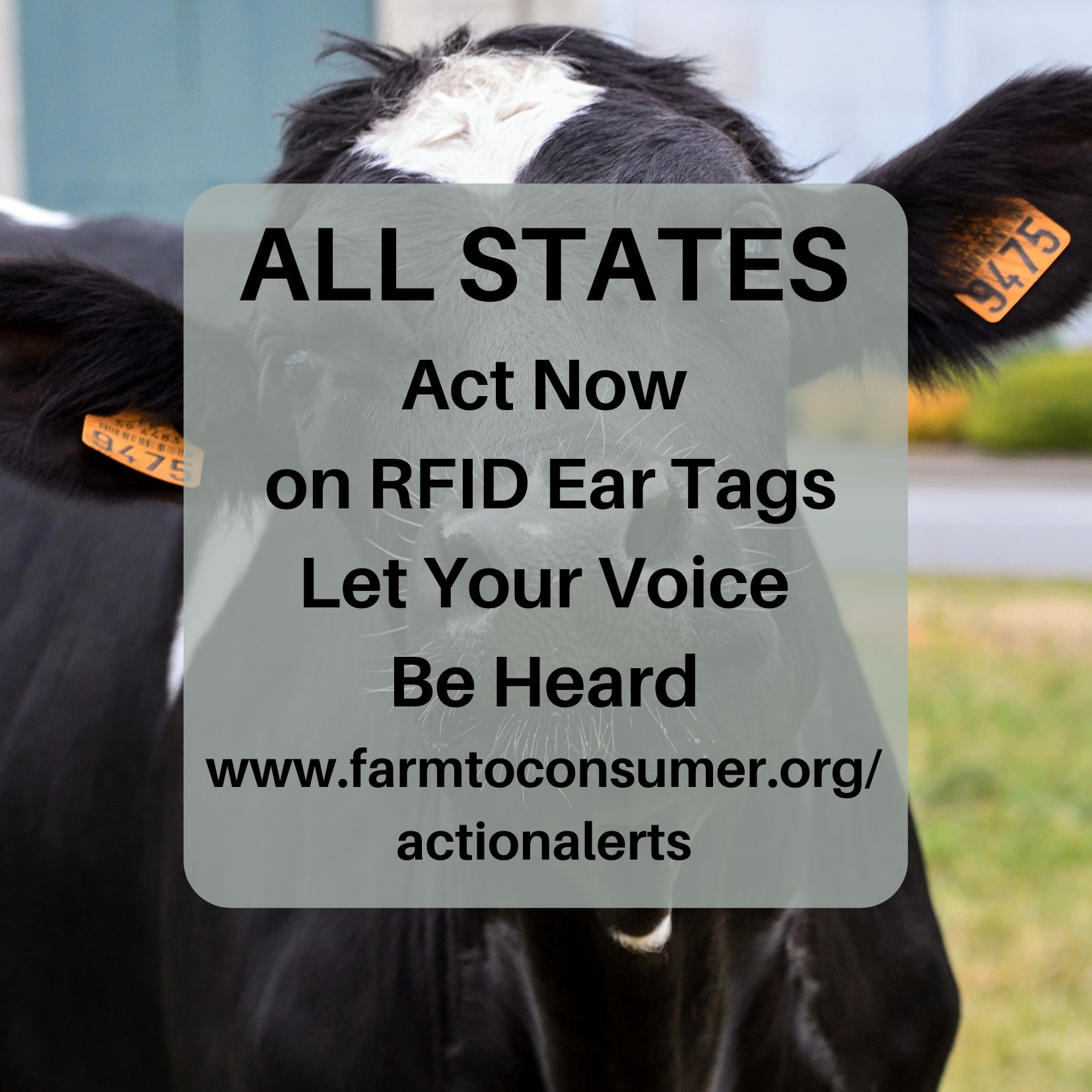
Subscribe | Give | Join | Renew ACTION ALERT: New Developments! Urge Your Senator to Oppose Mandatory Electronic ID! Dear Kirk,As you may have read in earlier emails or articles, Farm-to-Consumer Legal Defense Fund has been opposing the new USDA rule that requires mandatory visual and electronic identification of any cattle or bison that cross state lines. There have been a couple of new developments and FTLCLDF could really use your help. Background on RFID Ear Tags As a reminder, in late April 2024, the UDSA Animal and Plant Health Inspection Service(APHIS) finalized a rule that would require the use of Radio Frequency Identification (RFID) on any cattle and bison moving in interstate commerce. The rule benefits large meatpackers, while increasing cost, burden and risk for America’s independent ranchers and farmers. This is in part because the rule allows large meatpackers to obtain only one identification number for animals kept together from birth to slaughter, which is the model of the big feed yard, or CAFOs. In contrast, independent ranchers and farmers would be required to have different numbered tags, and the electronic equipment and infrastructure to monitor each individual animal. CLICK HERE for more on RFID tags. Pending Solutions There are two separate pending solutions to this USDA APHIS rule, and FTCLDF recommends that you support both. Rep. Hageman and Sen. Lummis Joint Resolution Rep. Harriet Hageman (R – WY) and Sen. Cynthia Lummis (R – WY) introduced a resolution pursuant to the Congressional Review Act that would nullify the new APHIS rule. FTCLDF encourages you to contact your U.S. Congressional Representatives and U.S.Senators in support of this resolution. If you are a constituent of a DemocraticRepresentative or Senator that you believe may be willing to help, we would particularly like to hear from you. To contact us, please reach out to Christine Dzujna at christine@farmtoconsumer.org. To learn more about the Hageman and Lummis Joint Resolution, please CLICK HERE. Sen. Rounds Bill In addition, On May 9, 2024, Sen. Mike Rounds (R – S.D.) introduced a simple bill (S. 4282) to that would prevent APHIS from implementing the rule. The bill reads, “The Secretary of Agriculture shall not implement any rule or regulation requiring the mandatory use of electronic identification ear tags on cattle or bison.” |
| TAKE ACTION Action Step #1 Call both of your U.S. Senators and Representatives and urge them to sign on to Reps Hageman and Lummis Joint Resolution and Sen, Rounds’ Bill! Find Your U.S. SenatorsFind Your U.S. Representatives Sample Script Hi, my name is ___ and I live in [STATE]. I am calling to ask my [Senator/Representative] to sign onto the Hageman and Lummis Joint Resolution and Senator Rounds’ bill, S. 4282, to stop electronic RFID ear tag mandates for cattle. I am concerned about this issue because I am [a rancher/farmer who relies on traditional metal tags; I am a small farmer in an isolated area without good access to tagging equipment; I am a consumer who wants to support local farmers, not international meatpackers]. … [You can add talking points from below, if you like – but the most important part is yourstory as a constituent!] 2. Spread the word: Share this information with your friends, family, and fellow farmers.Encourage them to also call their U.S. Senators and Representatives and voice their opposition to the mandate and their support for Rep. Hageman and Sen. Lummis Joint Resolution and Sen. Rounds’ Bill S. 4282)! Your action is vital to protect small farmers and ranchers and all those who depend on them for their food. Action Step #2 Spread the word! Please share this Action Alert with other ranchers, farmers, friendsand family. We need as many people to contact their elected representatives aspossible. Action Step #3 Keep informed! FTCLDF will continue to follow and report on this matter. For more information and background on RFID tags CLICK HERE.TALKING POINTS 1. The cost of RFID tags disproportionately burdens small and medium sized independent farmers and ranchers. 2. The USDA rule allows large, corporate-owned herds to be grouped and tagged as onegroup, creating a huge loophole that keeps costs low for big companies. 3. Although USDA claims the rule is about animal health, it does nothing to prevent ortreat disease. USDA hasn’t provided any data to show how it will significantly increasetraceback. The agency simply assumes electronic systems will be faster, even thoughthe experience in other countries, such as Australia, does not support this claim. 4. USDA’s press release focuses on the real driver for electronic ID, namely greasing thewheels of the export market. Exports benefit the big companies, while putting the cost onsmaller producers. 5. RFID tags on the live cattle do nothing to increase food safety.Pleasejoin us and spread the word about the importance of fair food and farming legislation. Thank you for taking action now! |
| GIVE TODAYOne minute is all it takes to process your $10, $20, $50, or $100 gift to Farm-to-Consumer Legal Defense Fund. Questions? Visit us on the web at www.farmtoconsumer.org or call our offices at (703) 208-FARM (3276). |
| 8116 Arlington Blvd Suite #263, Falls Church, VA 22042, United StatesYou may unsubscribe or change your contact details at any time. |
Read Between the Lines
Jun 6
Read between the lines. Government double-speak is a malarkey-mix of give and take, take and take. They tax productive American businesses $2.5 billion dollars, hire 20,000 new government employees and brag about the $2.5 going back into the economy as they purchase more private land to “protect” it. Every day there is a new move toward the 50×50 program for the government to own 50% of the US land mass by 2050. Obviously this is easy to understand as simple old “hard line communism.” The government wants control of all food producing land.
Ag and Interior Departments Invest $2.8 Billion to Protect Public Lands, Support Conservation Efforts
Historic investments from Great American Outdoors Act will support more than 20,000 jobs and contribute more than $2.5 billion to the economy
PUBLISHED ON

“The Great American Outdoors Act has enabled the Forest Service to begin to address our $8.6 billion deferred maintenance backlog, and we’re motivated by the impact these funded projects are having across urban and rural communities near our national forests and grasslands,” said Agriculture Secretary Tom Vilsack. “These investments in Forest Service infrastructure – including wildland firefighter and employee housing, recreation facilities, roads and trails – demonstrate the agency’s commitment to caring for the land and serving people.” (U.S. Department of Agriculture, Public domain)
WASHINGTON — The Departments of Agriculture and the Interior announced a proposed investment of $2.8 billion in fiscal year 2025 through the Great American Outdoors Act (GAOA) to protect and sustain our public lands and Bureau of Indian Education (BIE)-funded schools. Proposed projects will occur in all 50 U.S. states, Washington D.C., and multiple U.S. territories.
In August 2020, GAOA established the National Parks and Public Land Legacy Restoration Fund (LRF), authorizing up to $1.9 billion per year from fiscal year 2021 through 2025. GAOA LRF funding addresses overdue maintenance needs for critical facilities and infrastructure in our national parks and forests, national wildlife refuges, recreation areas, and BIE-funded schools. GAOA also provides permanent, full funding of the Land and Water Conservation Fund (LWCF) at $900 million annually to secure public access and improve recreation opportunities on public lands, protect watersheds and wildlife, and preserve ecosystem benefits for local communities.
Investments from GAOA work in concert with President Biden’s Investing in America agenda to strengthen our nation’s infrastructure and prepare it to meet future needs. These investments are an important part of enabling equitable access to the outdoors and meeting the commitments outlined in the America the Beautiful initiative, which is supporting locally led efforts to restore and conserve at least 30 percent of U.S. lands and waters by 2030.
“The Great American Outdoors Act has enabled the Forest Service to begin to address our $8.6 billion deferred maintenance backlog, and we’re motivated by the impact these funded projects are having across urban and rural communities near our national forests and grasslands,” said Agriculture Secretary Tom Vilsack. “These investments in Forest Service infrastructure – including wildland firefighter and employee housing, recreation facilities, roads and trails – demonstrate the agency’s commitment to caring for the land and serving people.”
“Addressing the long-delayed maintenance needs of the nation’s aging infrastructure allows safe and equitable access to our outdoor spaces, creates new jobs, and preserves our natural heritage. I was a proud champion of this proposal when I served in Congress, and it has been my honor to see the value it has created through the law’s implementation,” said Secretary of the Interior Deb Haaland. “Working together with state, local and Tribal governments, we are committed to ensuring that every child, family and community has access to nature and its benefits.”
National Parks and Public Land Legacy Restoration Fund (LRF)
For fiscal year 2025, the Department of the Interior has proposed 83 GAOA LRF projects and the Department of Agriculture has proposed 89 bundled GAOA LRF projects across all 50 U.S. states, the District of Columbia, and four U.S. territories to improve recreation facilities, water and utility infrastructure, BIE-funded schools, historic structures and other essential infrastructure. For the first time, the Interior Department will invest in all 50 states in a single funding year, helping ensure that the impact of GAOA LRF is felt across the country.
In total, these projects will support more than 20,000 jobs and contribute more than $2.5 billion to the economy. Economic contributions from GAOA LRF are far-reaching, as projects take place in urban, suburban, and rural areas across the U.S. and its territories.
GAOA LRF continues to serve as a critical funding source to make major investments that are normally out of reach with annual funding. GAOA’s LRF funding sunsets after fiscal year 2025 and would need to be reauthorized by Congress to continue the efforts underway to address significant infrastructure needs across public lands and BIE-funded schools.
Interior’s GAOA project page and Agriculture’s GAOA story map demonstrate the difference these projects are having on local communities by improving access and outdoor recreation opportunities across public lands.
Land and Water Conservation Fund (LWCF)
The fiscal year 2025 budget allocates $900 million for LWCF projects and programs managed by the Departments of the Interior and USDA Forest Service. This includes $437 million for federal land acquisition programs and projects, $455 million for state and local grants, and $8 million for a first-ever Tribal LWCF program.
The Department of the Interior will allocate $681.9 million for its mandatory funded LWCF programs, which includes $313 million for land acquisition. Land acquisition projects acquire critical lands or easements from willing sellers to protect at-risk natural, cultural, or historic resources including critical habitats and migration corridors, and increase access to outdoor recreation. The Interior Department will also invest more than $160 million to fund 48 projects in as many as 30 states across the country, in addition to smaller recreation access projects.
An additional $360.8 million for Interior’s LWCF grant programs will support locally driven state and local conservation and outdoor recreation, including through National Park Service formula grants and Outdoor Recreation Legacy Program (ORLP) grants. The ORLP enables urban communities to create new outdoor recreation spaces, reinvigorate existing parks, and form connections between people and the outdoors in disadvantaged communities.
In 2025, the Interior Department proposes $8 million to establish a new Tribal LWCF Land Acquisition program. The program will enable Tribes to directly participate in the LWCF for the first time to acquire lands for natural and cultural resource conservation and recreation access. The program will award funds for Tribal land acquisition projects consistent with the purposes of the LWCF and other program criteria.
In Fiscal Year 2025, the USDA Forest Service proposes $94.2 million to fund 13 Forest Legacy Program projects and $124 million to fund 16 Land Acquisition Program projects for recreation access and other needs.
These efforts advance President Biden’s Justice40 Initiative, which sets a goal that 40 percent of the overall benefits of certain federal climate, clean energy, affordable and sustainable housing, and other investments flow to disadvantaged communities that are marginalized by under investment and overburdened by pollution.
–USDA

By Chris Bennett April 30, 2024
How much acreage can a president take with the stroke of a pen? 10 million acres? 500 million acres? More?
The answer, says sixth-generation rancher Chris Heaton, is not a single acre beyond the law. Heaton’s livestock operation is at risk from the federal government’s latest land appropriation—a near million-acre claim by President Biden via the Antiquities Act through creation of the Ancestral Footprints National Monument.
Contending abuse of presidential authority, Heaton, in the crosshairs of potential fines and imprisonment for everyday activity on his ranch, has filed a federal lawsuit against Biden.
“My forefathers built this ranch and I’m not going to lose it on my watch,” Heaton says. “I’ll do this the proper way in the courts, and if Biden wants a fight, then he’s going to get one.”
A Weapon
In August 2023, Biden issued a proclamation turning 917,618 federal acres in northern Arizona into the Ancestral Footprints National Monument by wielding the power of the Antiquities Act, a law intended for the protection of archeological sites or landmarks and their immediate, surrounding acreage.
Biden dropped a blanket of government regulation on every inch of the Monument, an area 150,000 acres larger than Yosemite, and 75,000 acres bigger than the Grand Teton National Park and Great Smoky Mountains Park put together. Biden’s proclamation covers landscapes, species, and objects—named and unnamed—within all 917,618 acres, including plateaus, canyons, tributaries, remnants of homes, storage buildings, pottery, tools, other physical remnants of human habitation, 50 species of plants, groundwaters that flow into the Colorado River, geological features, cliffs, faults, deserts, grasslands, woodlands, forests, riparian vegetation, and a variety of endangered species.

“Normal ranching is now gone here, and that’s what my family has practiced for decades,” Heaton insists. “Overnight, we’re not allowed to disrupt or destroy objects, both known and unknown, on the Monument. We literally don’t know all the objects because some are listed and some are not, yet they have associated criminal penalties. This is like putting someone in a game and expecting them to play by the rules—without telling them the rules.”
On a mix of private land and acres leased from Arizona and the Bureau of Land Management, Heaton, 37, runs cattle on 48,603 acres now overlapped by the Monument. He has three federal grazing permits and 47 private water rights.
Every day of the year, Heaton’s 200 cow pairs are on land designated for the Monument. In daily rhythm, Heaton and his family tend livestock, clean water holes, cut overgrowth, remove silt, mend fences, drop minerals, chop ice, repair roads, and a host of other standard production practices—all now in jeopardy.
In February 2024, represented by Pacific Legal Foundation (PLF), Heaton filed suit against Biden; Secretary of Agriculture Tom Vilsack; Secretary of Interior Deb Haaland; and Bureau of Land Management Director Tracy Stone-Manning.
(DOJ, USDA, DOI, and BLM all declined Farm Journal requests for comment on Chris Heaton’s suit.)
“We’re asking a federal court to check Biden’s executive overreach,” says PLF attorney Adam Griffin. “Biden has taken 1 million acres and said a ‘landscape’ is an object and everything on it is an object. Look at the absurdity: The entire landscape Chris Heaton is on is now a national monument. How does a landscape become an object? I’ve never heard anyone in my life look at a landscape and say, ‘That’s a beautiful object.’”
PLF attorney Frank Garrison says the Biden administration is making “law through proclamation.”
“Only Congress can pass such laws—not the president. Biden is using a work-around to pass regulations that could never get through Congress, and the impact hits people who rely on natural resources to make a living,” Garrison notes. “Chris Heaton is in compliance with all land use statutes, but suddenly the government can turn him into a criminal over his everyday ranching activities.”
“If anyone wants a clear picture of how government power expands to all-powerful levels,” Griffin echoes, “look no further than what has become a weapon in the hands of the president—the Antiquities Act.”
“Does The Law Not Matter?”
In 1906, at the urging of Theodore Roosevelt, Congress passed the Antiquities Act. Contained on a single page, a mere 441 words authorized the president to “declare by public proclamation historic landmarks, historic and prehistoric structures, and other objects of historic or scientific interest that are situated upon the lands owned or controlled by the Government of the United States to be national monuments…”

Congress approved the Antiquities Act to allow a president to protect specific locations in tight crosshairs, evidenced by congressional debate on whether monuments should be limited between 320 to 640 acres. (Congress kept the power to create big-acreage national parks to itself, having started with the establishment of Yellowstone in 1872.)
At passage of the Antiquities Act, the text allowed a president to “reserve as a part thereof parcels of land, the limits of which in all cases shall be confined to the smallest area compatible with proper care and management of the objects to be protected…”
Over the next 120 years, the “smallest area” ballooned to millions of acres, and “objects” expanded to ecosystems. Since 1906, successive presidents have used the Antiquities Act to cordon off staggering swathes of land—roughly 800 million acres in total.
Turns out, the race for land in U.S. history never ended, with Uncle Sam still leading the scramble—never mind the law or Constitution. In recent decades, multiple presidents have vastly increased acreage claims for national monuments. Jimmy Carter; 55 million acres. Bill Clinton; 5 million acres. George W. Bush; 215 million acres. Barak Obama; 554 million acres (mainly via two marine monuments).
“They act as if there is no limiting principle,” Garrison says, “but that’s not how our Constitution works. What next? If a president can designate species, landscapes, ecosystems, and amorphous concepts like objects, then how much land can a president rope off next? The entire West?”
Heaton, via his lawsuit, asks glaring questions: “Does the law not matter? Does the will of the people not matter? Do the reps, senators, state legislators, county boards, and resolutions not matter? One president gets total control and the people and elected officials mean nothing?”
Ranching, Mining, Logging?
Heaton’s Y-Cross Ranch is 40 miles north of the Grand Canyon. He has worked the land, once in the shadows of his father and grandfather, since the age of 8. “My family ranched here before BLM existed. We take care of the land, pay grazing fees, and get nothing for free. There are national monuments with millions of acres all around us in Arizona and Utah, but if you talk to people in coffee shops, grocery stores, or regular folks on the street, you find out that our local economies are strangled because the government forces our area to be dependent on tourism.”
“Ranching, mining, or logging—the government wants to control all of it or shut it down,” Heaton says. “That’s why presidents in the past, and Biden now, are willing to ignore the law. My ranch and many, many other producers are in the crosshairs of his control.”
(Northern Arizona is estimated to have at least 2.6 billion pounds of uranium. In 2022, 95% of uranium needed by U.S. nuclear power plants was imported from foreign countries, including Russia.)
“Special interest groups turned to the president to get this land under federal control because they knew it couldn’t be done legitimately through congress,” concurs PLF attorney Adam Griffin. “However, before this much federal land is locked up, the process should go to the people through their reps in Congress. It shouldn’t be, and wasn’t intended to be, up to a single individual.
Whose Wishes?
Will Heaton’s lawsuit, or a similar case, eventually land before the Supreme Court of the United States (SCOTUS)?

In 2021, SCOTUS declined to hear Massachusetts Lobstermen’s Association v. Raimondo, an Antiquities Act-related case triggered when Obama declared 5,000 square miles of ocean to be a national monument and banned all fishing, but Chief Justice John Roberts expressed concern in a four-page statement:
While the Executive enjoys far greater flexibility in setting aside a monument under the Antiquities Act, that flexibility, as mentioned, carries with it a unique constraint: Any land reserved under the Act must be limited to the smallest area compatible with the care and management of the objects to be protected. Somewhere along the line, however, this restriction has ceased to pose any meaningful restraint. A statute permitting the President in his sole discretion to designate as monuments “land- marks,” “structures,” and “objects”—along with the smallest area of land compatible with their management—has been transformed into a power without any discernible limit to set aside vast and amorphous expanses of terrain above and below the sea.
The Antiquities Act began as a simple measure to protect the past: When the legislative branch via Congress put the ball in motion, the executive branch via the president took the ball and ran. Heaton contends the president has run beyond the Constitution.
“I’m suing because Biden assumes he has power to affect the livelihoods of so many people in agriculture and other industries with a baseless declaration,” Heaton concludes. “He wants to act according to his own wishes, but I’m demanding he act according to the law.”
For more articles from Chris Bennett (cbennett@farmjournal.com or 662-592-1106), see:
- Power vs. Privacy: Landowner Sues Game Wardens, Challenges Property Intrusion
- Corn and Cocaine: Roger Reaves and the Most Incredible Farm Story Never Told
- American Gothic: Farm Couple Nailed In Massive $9M Crop Insurance Fraud
- Priceless Pistol Found After Decades Lost in Farmhouse Attic
- Cottonmouth Farmer: The Insane Tale of a Buck-Wild Scheme to Corner the Snake Venom Market
- Tractorcade: How an Epic Convoy and Legendary Farmer Army Shook Washington, D.C.
- Bizarre Mystery of Mummified Coon Dog Solved After 40 Years
- While America Slept, China Stole the Farm
The Rise of Global Governance
By Henry Lamb
The desire to rule the world has been a part of the human experience throughout recorded history. Alexander the Great led Greece to dominance of the known world, only to become the victim of Rome’s quest for world dominance. The Roman Empire, built on bloody battlefields across the land, was swallowed up by the Holy Roman Empire, built on the fear and hopes of helpless people. History is a record of the competition for global dominance. In every age, there has always been a force somewhere, conniving to conquer the world with ideas clothed in promises imposed by military might. The 20th century is no different from any other: Marx, Lenin, and Hitler reflect some of the ideas which competed for world dominance in the 1900s. The competition is still underway. The key players change from time to time, as do the words that describe the various battlefields, but the competing ideas remain the same.
One of the competitors is the idea that people are born free, “totally free and sovereign,” and choose to surrender specified freedoms to a limited government to achieve mutual benefits. The other competitor is the idea that government must be sovereign in order to distribute benefits equitably and to manage the activities of people to protect them from one another. The first idea, the idea of free people, is the idea that compelled the pilgrims to migrate to America. The U.S. Constitution represents humanity’s best effort to organize and codify the idea of free people sovereign over limited government. It is a relatively new idea in the historic competition for world dominance.
The other idea, the idea of sovereign government, is not new. Historically, the conqueror was the government. The Emperor, the King, the conqueror by whatever name, established his government by appointment and established laws by decree. Variations of this idea emerged over time to give the perception that the people had some say in the development of law. The Soviet Union, for example, held elections to choose its leaders; but the system assured the outcome of the elections as well as the ultimate sovereignty of the government. During the 1700s, the first idea was ascendant as evidenced by the creation of America. During the 1900s, the second idea has again become ascendant as evidenced by the emergence of global governance. This report identifies and traces some of the major forces, events, and personalities that are responsible for the rise of global governance in the 20th century.
The documented history of Global Governance – Why, How, and When
https://www.iatp.org/sites/default/files/Global_Governance_Why_How_When.htm


Dear Kirk,
We invite you to follow us on social media for the latest updates.