‘Climate Crisis’ is Just a Pretext to Steal Land, Implement Globalist Agenda: Eva Vlaardingerbroek
May 10

The Supreme Court handed a major win for personal property rights across the country, in a decision that essentially went into a media black hole once it was passed.
Specifically, in a unanimous decision, the U.S. Supreme Court significantly limited the scope of the Clean Water Act, and in so doing, limited the federal government’s ability to dictate what you can or cannot do on your own property.
To explain the details as well as the implications that this case has for everyday Americans, let’s go through it together.
🌽No Farmers No Food DVD:
‘When you take off access to our resources … this is the energy insecurity that we’re talking about,’ Rep. Lisa Murkowski (R-Alaska) said.


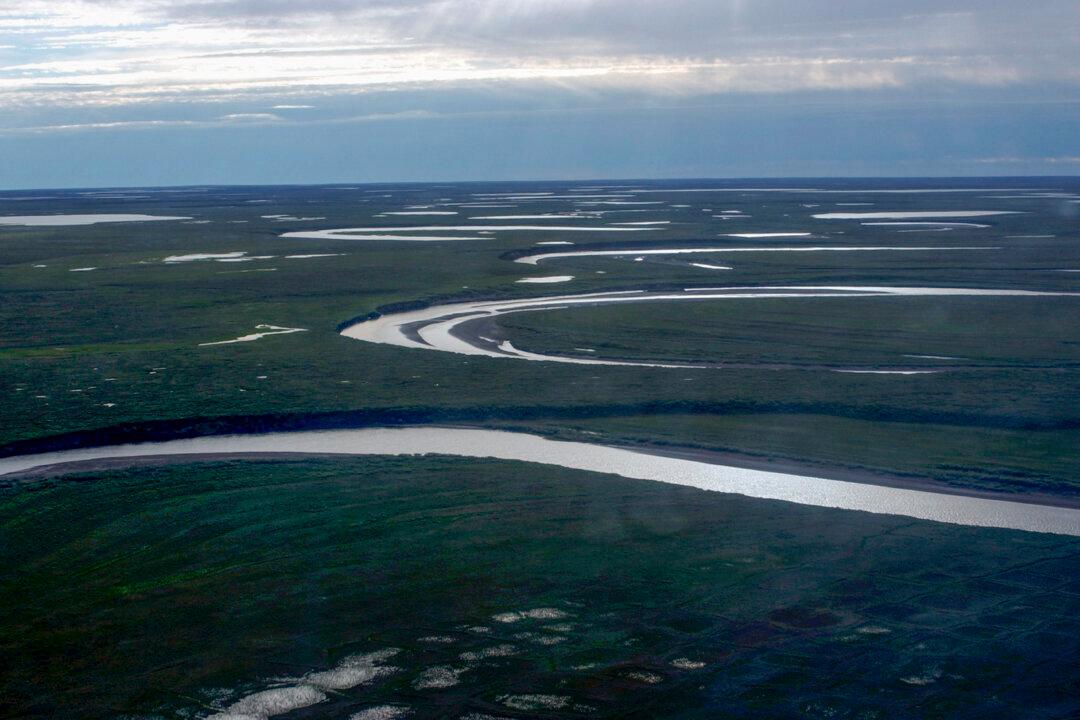
Fish Creek through the National Petroleum Reserve-Alaska, managed by the Bureau of Land Management on Alaska’s North Slope, on July 8, 2004. (David W. Houseknecht/United States Geological Survey via AP)
The Biden administration took action on Friday to restrict new oil and gas drilling on more than 13 million acres of land in the western Arctic region.
The U.S. Department of Interior announced the publication of a final rule on Friday, limiting future oil and gas leasing and industrial development in the Teshekpuk Lake, Utukok Uplands, Colville River, Kasegaluk Lagoon, and Peard Bay Special Areas. Together, these areas cover around 13.3 million acres of land in the National Petroleum Reserve Alaska (NPR-A).
The Interior Department said these areas of Alaska are known for significant globally significant wildlife habitats, including those of grizzly and polar bears, caribou, and hundreds of thousands of migratory birds.
“Alaska’s majestic and rugged lands and waters are among the most remarkable and healthy landscapes in the world, sustaining a vibrant subsistence economy for Alaska Native communities,” President Joe Biden said Friday. “These natural wonders demand our protection. I am proud that my Administration is taking action to conserve more than 13 million acres in the Western Arctic and to honor the culture, history, and enduring wisdom of Alaska Natives who have lived on and stewarded these lands since time immemorial.”
The new rule doesn’t necessarily change the terms for existing leases in the NPR-A or affect currently authorized operations. Instead, the rule specifies these areas are generally closed to new leasing and infrastructure projects.
The rule provides exceptions, including allowing the Bureau of Land Management (BLM) to permit new leasing and infrastructure in cases where an existing well may be draining an otherwise restricted Federal or Indian oil or gas resource. Another exception allows BLM to approve new roads, pipelines, and transmission lines if they deem these projects will benefit local communities and include measures that assure maximum resource protection. BLM may also allow for new infrastructure if they deem it “essential for exploration or development activities” and “no practicable alternatives exist” that would have less adverse impacts on the local environment.
Today’s historic actions to protect lands and waters in the western Arctic will ensure continued subsistence use by Alaska Native communities while conserving these special places for future generations,” said John Podesta, the Senior Advisor to the President for International Climate Policy.
With this latest rule announcement, Mr. Podesta credited the Biden administration with extending protections over 41 million acres of lands and waterways across the United States in his presidency, “leaving a huge mark on the history of American conservation.”
New Rule Follows Contentious Willow Project Approval
The new restrictions on oil and gas extraction operations in the NPR-A come just over a year after the Biden administration approved a scaled-back version of a new drilling operation, proposed by ConocoPhillips, dubbed the Willow Project.
ConocoPhillips had acquired the leases for the Willow Project in the 1990s and had sought for years to begin drilling. In their scaled-back approval, the Biden administration allowed three of the five proposed drilling pads to proceed, while ConocoPhillips relinquished 68,000 acres of its NPR-A leases and abandoned infrastructure development plans for the two canceled drilling pads that would have included 11 miles of roads, 20 miles of pipelines, and 133 acres of gravel.
The decision to approve the scaled-back Willow Project drew criticism from environmental activists.
Abbie Dillen, president of environmental group Earthjustice, said the Willow Project’s approval “hands over one the most fragile, intact ecosystems in the world to ConocoPhillips.”
Sen. Ed Markey (D-Mass) called the Biden administration’s decision an “environmental injustice” that “leaves an oil stain on the administration’s climate accomplishments and the president’s commitment not to permit new oil and gas drilling on federal land.”
Though this new rule does not reverse the earlier decision to approve the Willow Project, environmental groups applauded the latest move.
“We applaud the Biden Administration for this important step to increase protections for 13 million acres of the Western Arctic to safeguard the irreplaceable ecosystems and wildlife found there,” Ms. Dillen said Friday.
Earthjustice still said more action is needed “to ensure that the oil industry does not cause further damage to the Reserve.” In a Friday press statement, the group noted ongoing litigation challenging the Willow Project’s approval.
“For more than a year, millions of people called on President Biden and his administration to stop the extraction on these lands – extraction that every year drives us closer to climate catastrophe,” Sierra Club Executive Director Ben Jealous said of the new rule. “Thankfully, the Biden administration listened.”The new limits on oil and gas leasing in the NPR-A come a week after the Interior Department announced it had raised fees associated with operating oil and gas leases throughout the country.
Alaska Senators Rebuke New Ruling
A group of Republican lawmakers, led by Alaska Sens. Dan Sullivan and Lisa Murkowski, spoke out on Thursday evening ahead of Friday’s announcement. The lawmakers accused the Biden administration of hindering U.S. energy independence and making the United States more reliant on oil from adversary countries like Russia, Iran, and Venezuela.
“When you take off access to our resources, when you say you cannot drill, you cannot produce, you cannot explore, you cannot move it—this is the energy insecurity that we’re talking about,” Ms. Murskowski said.
Mr. Sullivan called the new decision a “clearly illegal” attack on Alaska’s economic engine. Mr. Sullivan also challenged assertions coming through the Biden administration that the new actions were being taken with Alaskan Native communities in mind.
“Joe Biden is lying. The elected Alaska Native leaders who live in the area vehemently oppose this rule on NPR-A,” Mr. Sullivan said in a Friday social media post.
The American Exploration & Production Council (AXPC), a trade association for the oil and natural gas exploration and production industry, also condemned the new rules.
“AXPC companies support and encourage proper land management and conservation, but this latest rule is inconsistent with and outside the bounds of BLM’s statutory authority, and is part of the Biden administration’s playbook to restrict American energy production,” AXPC CEO Anne Bradbury said Friday.
Ms. Bradbury argued the new rule oversteps the authority given to the BLM under the Federal Land Policy and Management Act and the Mineral Leasing Act, and said AXPC is evaluating its next possible steps to challenge the rule.
This was the boast of ODNR published by Farm and Dairy. They are proud of their history of taxing the
Ohio residents and buying their land from them. To buy thousands more acres all they have to do is raise taxes. Their plan is clear. The damage is plain.

Memo: This is a clear bamboozling-documentation of the ignorance and flawed judgement of the government. Please note the government took tax money and purchased forest lands from private citizens, therefore taking all income from the tax rolls so no local private property income would come from these lands for local services. This becomes government protected lands. The government doesn’t pay taxes to anyone. When government “protects” lands it stops cattle grazing, fee hunting, farming, oil and mineral exploration. All commerce ends with government ownership.
After land is “protected” from private use it no longer has commercial value. It becomes like a dead-asset once owned by the government.
Townships, counties and states are suffering huge financial losses from government land purchases. The article below by the USDA Forest Service is a self incriminating report of the damage the government is bringing upon private citizens. In true government fashion the cure is as full of malarkey as the original problem.
Now they propose to tax the citizens more in order to repay the areas for the loss of private property income.
No private owner would be dumb enough to handle business like the government. No matter how humongous their financial errors are, they will tax enough to pay the costs. We pay!!
They are not investing--they are taxing with our money and paying for some of their damages to the citizens and wanting citizens to think they are being “nice” people.
Do you see who the government is? The feds own 305,502 acres in Ohio and propose paying $228,088 back to eligible counties of their choice–less than $1 per acre. Maybe they should tax the citizens more and then they could pay back the citizens more-less administration fees.
If this makes you puke, you are a normal person. D
USDA Forest Service Invests $232M+ to Support Schools, Roads, Other Services
Fiscal year 2023 funds will be paid to 745 eligible counties in 41 states and Puerto Rico
PUBLISHED ON

“The Secure Rural Schools program is just one of the ways the Forest Service supports communities nationwide,” said Forest Service Chief Randy Moore. “This funding aids schools and roads, reimburses counties for national forest emergency services, and assists in creating community wildfire protection plans – all critical programs designed to enhance the quality of life in these communities.” (Photo: Forest Service, USDA, Public domain)
WASHINGTON — The U.S. Department of Agriculture’s Forest Service today announced it is issuing more than $232 million to support public schools, roads and other municipal services through the agency’s Secure Rural Schools program. As the Biden-Harris administration invests in ways for forests to generate more economic opportunity in rural areas, it also aims to support the quality of life in those communities through programs like Secure Rural Schools. The program was reauthorized for fiscal years 2021 through 2023 through President Biden’s Bipartisan Infrastructure Law. Fiscal year 2023 funds will be paid to 745 eligible counties in 41 states and Puerto Rico.
“National forests and grasslands cover more than 193 million acres, including across rural counties that are important partners in helping sustainably manage resources,” said Agriculture Secretary Tom Vilsack. “Thanks to President Biden’s Bipartisan Infrastructure Law, the Secure Rural Schools program is able to contribute to the economic vitality and well-being of the communities intertwined with our forests.”
“The Secure Rural Schools program is just one of the ways the Forest Service supports communities nationwide,” said Forest Service Chief Randy Moore. “This funding aids schools and roads, reimburses counties for national forest emergency services, and assists in creating community wildfire protection plans – all critical programs designed to enhance the quality of life in these communities.”
In addition to Secure Rural Schools payments, the Forest Service is using Bipartisan Infrastructure Law and Inflation Reduction Act funding to improve forest conditions, support local economies and create jobs by investing in forest restoration projects, road and trail maintenance, recreation opportunities and wood innovation development.
Over the past 10 years, the Forest Service has distributed $2.4 billion through the Secure Rural Schools program.
The Forest Service retains some of the funding to support projects that improve forest conditions and support jobs in rural communities. Resource advisory committees made up of residents representing varied interests and areas of expertise review and recommend the projects that meet their local needs.
This year’s payments to states are below:
| States | Payments |
|---|---|
| Alabama | $1,643,523 |
| Alaska | $10,314,755 |
| Arizona | $8,869,762 |
| Arkansas | $5,400,021 |
| California | $33,720,305 |
| Colorado | $12,574,121 |
| Florida | $2,223,095 |
| Georgia | $1,170,257 |
| Idaho | $21,552,395 |
| Illinois | $549,818 |
| Indiana | $221,350 |
| Kentucky | $1,352,826 |
| Louisiana | $1,571,793 |
| Maine | $61,140 |
| Michigan | $3,448,901 |
| Minnesota | $2,243,841 |
| Mississippi | $4,614,710 |
| Missouri | $2,639,657 |
| Montana | $13,396,642 |
| Nebraska | $176,796 |
| Nevada | $4,149,561 |
| New Hampshire | $447,052 |
| New Mexico | $9,309,362 |
| New York | $19,091 |
| North Carolina | $1,469,497 |
| North Dakota | $251 |
| Ohio | $228,088 |
| Oklahoma | $764,330 |
| Oregon | $47,782,384 |
| Pennsylvania | $3,135,476 |
| Puerto Rico | $171,857 |
| South Carolina | $1,458,678 |
| South Dakota | $1,122,288 |
| Tennessee | $1,035,900 |
| Texas | $1,800,075 |
| Utah | $7,287,609 |
| Vermont | $299,856 |
| Virginia | $1,385,662 |
| Washington | $15,181,392 |
| West Virginia | $1,486,097 |
| Wisconsin | $1,674,092 |
| Wyoming | $4,461,02 |
| TOTAL: | $232,415,330 |
For payment information by county, visit Secure Rural Schools – Payments | US Forest Service.
Background:
In the years after the Forest Service was established in 1905, the national forest system tripled in size, growing from 56 million in 1905 to 172 million acres in 1908. To compensate counties for potential losses of tax revenue from this early growth, Congress ratified the Act of May 23, 1908. The Act allowed the Forest Service to distribute a portion of agency revenues from timber sales, mineral leases, recreation, grazing and other sources to those states and counties containing national forests and grasslands.
Agency revenues from these activities declined in the late 20th century. In response, Congress passed the Secure Rural Schools and Community Self-Determination Act of 2000 to help stabilize fiscal support for rural county services. In 2021, the Bipartisan Infrastructure Law reauthorized Secure Rural Schools payments through fiscal year 2023.
Each state’s Secure Rural School payment amount is determined by various factors established in the law, including the number of counties that elect to share in a state’s payment. Payments to states are distributed after the Forest Service collects revenue to accommodate those counties electing to continue participation in revenue sharing rather than the Secure Rural School payment.
The mission of the USDA Forest Service is to sustain the health, diversity, and productivity of the nation’s forests and grasslands to meet the needs of present and future generations. The agency manages the 193 million acres of National Forest System land, provides stewardship assistance to non-federal forest landowners, and maintains the largest forestry research organization in the world.
USDA touches the lives of all Americans each day in so many positive ways. Under the Biden-Harris Administration, USDA is transforming America’s food system with a greater focus on more resilient local and regional food production, fairer markets for all producers, ensuring access to safe, healthy and nutritious food in all communities, building new markets and streams of income for farmers and producers using climate-smart food and forestry practices, making historic investments in infrastructure and clean energy capabilities in rural America, and committing to equity across the Department by removing systemic barriers and building a workforce more representative of America. To learn more, visit www.usda.gov.
–USDA Forest Service

According to a new analysis prepared by the Center for American Progress (CAP), the progressive organization pushing for the preservation of at least 30 percent of our lands and oceans by 2030, the Biden administration has added a record 24 million acres – and counting!
Half of those 24 million – 12.5 million acres, was locked down in 2023 alone, according to the CAP analysis. In addition, the administration has funneled more than $18 billion into “conservation” projects.
Some of the projects protected in 2023 include:
- 506,814 acres for the Avi Kwa Arne National Monument in Nevada.
- 917,618 acres for the Ancestral Footprints of the Grand Canyon National Monument in Arizona.
- 130,000 acres for lease relinquishments in Montana’s national forest.
- 223,504 acres for mineral withdrawal in Minnesota’s national forest.
- 325,000 acres for Chaco Canyon mineral withdrawal in New Mexico.
- 10,600,000 acres for Western Arctic protections closing oil and gas leasing in Alaska.
- 242,000 acres nationwide for the U.S. Fish and Wildlife’s Wetland’s Conservation projects.
CAP stressed the president should “focus on finalizing strong protections to conserve more lands through ongoing rulemakings such as BLM’s Public Lands Rule and Western Arctic conservation rule, …BLM management plans, restoring protections for tens of millions of acres in Alaska…keeping up the administration’s ambitious and wildly supported pace of protections…”
The Center emphasized Biden’s use of national monument designations and applauded his creation of five new national monuments and the restoration of two more rolled back under the Trump administration. With these seven monuments, Biden has protected 3.5 million acres of land with the stroke of his pen.
They claim if President Biden protects an additional 215,000 acres under the Antiquities Act of 1906, he will “set the record of monument protection by acreage among recent presidents…”
“Conservation funding” has also increased. Biden has thrown $18 billion toward federal, state, local, and Tribal land conservation in all 50 states. Importantly for agriculture, the U.S. Department of Agriculture announced its first round of Inflation Reduction Act grants for farm bill conservation programs at $1.7 billion for “climate-smart agriculture and conservation.”
The Inflation Reduction Act was nothing more than a gigantic political slush fund disguised as climate change protections so Biden could throw as much money at his liberal friends and buy as many votes as possible. It also serves the purpose of casting a federal nexus onto private property, potentially triggering federal land use restrictions in the future. It has nothing to do with saving the environment. It’s all about politics, control, and money.
CAP recommends the “administration should not be shy in utilizing every tool at its disposal as it approaches 2024. Doing so will put communities first and keep the country on track toward achieving 30×30.”
CAP Analysis: https://www.americanprogress.org/article/the-biden-administration-has-reached-conservation-records-in-2023/
Land Ownership
Apr 9
Memo: On April 3 a Town Hall meeting was held by the Egypt Valley Wildlife Refuge Committee with all area land-owners invited. Author and special speaker Tom Deweese spoke on government confiscation of lands and what recourse citizens have against this heavy-handed takings. The event was well
attended by elected representatives and filmed by Fox news 9. Photos of the event with a written presentation of losses caused by ODNR from their lack of management of the property were presented. Copy below. DD


EGYPT VALLEY RECOVERY/ DEVELOPMENT
“As citizens, we all have an obligation to intervene in government
and become involved – it’s the citizen who stops the bleeding.”
The day President Biden was sworn in he made mention of his 30×30 goal. Later he added a 50×50 goal to his list of future plans.
The 30×30 is a plan for the government to own 30% of the USA by 2030, then 50% by 2050. This is a flawed Agenda 21 plot that the people can not manage and should not own land—the government should be the owner of all land and all production.
This is their end game. The reason for the 30×30 land grab. The purpose for the climate crisis hysteria. We will own nothing. They will own everything. ~Margaret Byfield
In three years the government has added 24,000,000 acres to government ownership, the most of any administration. This land is taken out of private enterprise and removed from the tax base. More land “takings” are planned and states are conspiring with the feds to help confiscate these private properties. Under words like “conservation,” “wildlife refuges,” “natural areas,” “parks,” “protected lands,”and “public lands” these acres are adding up by the millions with names that are designed to be palatable to tax payers.
“Governments are capable of absolutely anything because they consider their citizens
a national resource available for exploitation, almost like cattle.” ~Doug Casey
LOSS DAMAGE REPARATIONS FROM ODNR:
- Back tax-base loss-recovery up to 28,000 acres
- Development of lake and tourist park shelters as promised
- Purchase of road maintenance equipment for Kirkwood TSP
- Development of public water system for area use from 100 acre lake.
- Open season year around on ODNA released predators, river otter, lions, bob cats, ferrets, etc., without licenses or fines.
- Income from land use including oil leases payable for local use.
DEVELOPMENT FUNDING:
- Immediate release of certain parcels for cash sales
- Immediate release of all parcels where oil/gas leasing is possible
- Release contracts for all select cut mature timber
- Land liquidation will not be sold multi-parcel auction.
- Funds acquired from Belmont County lands will be returned to Belmont County for public roads, tourist development, etc.
ASSET VALUES TAKEN FROM BELMONT COUNTY CITIZENS:
- Loss from property tax 28 years at $11 per a 28,000 a = $8,932,000
- Loss surface lease agriculture use or recreation 28,000 a x $30 per acre = $840,000 per year x 28 years = $24,360,000.
- Oil/gas leases signing-deposits $5000 per acre = $140,000,000.
- Future oil/gas royalties per year 35 years $__________________?
- Liquidation surface 28,000 a $2000 per acre = $56,000,000
- Private enterprise loss of collateral-investment-value (lending can be up to 75% of value.)
- Loss to local citizens from private property taxes, income, food production, etc
- Under full agriculture production, fee hunting plus oil and gas production can work together producing income from all sources at the same time with intelligent management. $_______________________________________________
ORDERLY LIQUIDATION:
- Liquidation time estimate, 2 to 12 years
- Sell all EVWR property except selected scenic areas for attractive maintained recreation of no more than 1000 acres.
- Liquidation, research and management by an elected BOD from the area.
- Restock useful wildlife introductions, after predator removal program, releasing turkey, quail, grouse, chukars, pheasants, etc.
- Provide public water from 100 acre lake with taps in Fairview and Hendrysburg. (Land liquidation pays all installation main line costs)
- No new acquisition lands will be removed from private property in the future.
Other considerations:
DEATH BY 1000 CUTS
Mar 22
by: Darol Dickinson
During the Tang Dynasty (A.D. 618-907), the most dastardly enemies of Imperial China suffered a process of slow torture and eventual death. It was a punishment that shoots fear up the spine even today, more than a thousand years later.
In world history, few methods of execution were as gruesome as the “Lingchi”—better known as Death by 1000 Cuts. For those who have never been hanged, electrocuted, or shot by firing squad, the Lingchi should be your last choice of a way to die. Its details evolved into an art form that allowed the victim always to die eventually, but slowly. The worse the crime, the longer the torture. The Lingchi’s success in each case was evaluated by how long the punishment could be stretched out. This process was used by the government as a public spectacle to instill fear. It was famous worldwide as a show of power, extreme severity, and Imperial Chinese savagery.
Slightly different but like the methods of the Lingchi is President Biden’s 2024 State of the Union Address. It includes a proposed budget of $7.3 trillion for fiscal 2025, with a categorical 25% tax on billionaires. (Billionaires are the ones who own businesses and hire the most employees.) Like Lingchi, this budget proposal is not designed for a quick, bloody death, but rather a slow sucking away of private assets. Its unstated goal is to equalize outcomes across the entire US population. That is a mission that makes individuals’ prosperity less likely and their survival under government stabulation ever harder.
Overtly, this $7.3 trillion budget includes a plan to sequester millions of acres of productive land for “the greater good.” Buried in it, however, is a covert scheme to take land away from private enterprise and “protect”—that is, remove—it from farm/food production and oil and mineral exploration. This confiscatory plan is an open secret, because the public has already been forewarned.
When Joe Biden was inaugurated in 2021, he immediately announced a 30×30 project to take 30% of US land from private enterprise by 2030 and retire it—i.e., make it dormant—ostensibly for “the greater good.” Soon after that, he announced his 50×50 plan, and then a grand, even-larger 70×70 plan.


To visualize the government plan. Consider the dwindling size of remaining land private-ownership with each increasing increment of government land-grab.
These proposals have ominous parallels to the Chinese Lingchi as well as to collectivist politics. Specifically, in the playbook of any communist or other authoritarian takeover, the first step is to control land, then to control production of all goods and services, and finally to control all the people. This method of long-term, covert acquisition is clearly defined in the Communist Manifesto. The strategy is clear to those who do their research.
The following table shows federal land ownership state-by-state in 2018. Today, six short years later, the total includes millions more acres. In January 2024, President Biden announced success in acquiring 24,000,000 acres for his 30×30 program, now renamed “America the Beautiful.” That new name for his initiative is a euphemism—a phrase that sounds more patriotic, sanitary, and benign than a heavy-handed government takeover of 30, 50 or 70% of private property in the USA.
Federal land ownership by state (as of 2018) | |||
|---|---|---|---|
State | Federal land | Total state acreage | Percentage of |
880,188 | 32,678,400 | 2.7% | |
222,666,580 | 365,481,600 | 60.9% | |
28,077,992 | 72,688,000 | 38.6% | |
3,159,486 | 33,599,360 | 9.4% | |
45,493,133 | 100,206,720 | 45.4% | |
24,100,247 | 66,485,760 | 36.2% | |
9,110 | 3,135,360 | 0.3% | |
29,918 | 1,265,920 | 2.4% | |
District of Columbia | 9,649 | 39,040 | 24.7% |
4,491,200 | 34,721,280 | 12.9% | |
1,946,492 | 37,295,360 | 12.9% | |
829,830 | 4,105,600 | 20.2% | |
32,789,648 | 52,933,120 | 61.9% | |
423,782 | 35,795,200 | 1.2% | |
384,726 | 23,158,400 | 1.7% | |
97,509 | 35,860,480 | 0.3% | |
253,919 | 52,510,720 | 0.5% | |
1,100,160 | 25,512,320 | 4.3% | |
1,353,291 | 28,867,840 | 4.7% | |
301,481 | 19,847,680 | 1.5 | |
205,362 | 6,319,360 | 3.2% | |
62,680 | 5,034,880 | 1.2% | |
3,637,599 | 36,492,160 | 10.0% | |
3,503,977 | 51,205,760 | 6.8% | |
1,552,634 | 30,222,720 | 5.1% | |
1,702,983 | 44,248,320 | 3.8% | |
27,082,401 | 93,271,040 | 29.0% | |
546,852 | 49,031,680 | 1.1% | |
56,262,610 | 70,264,320 | 80.1% | |
805,472 | 5,768,960 | 14.0% | |
171,956 | 4,813,440 | 3.6% | |
24,665,774 | 77,766,400 | 31.7% | |
230,992 | 30,680,960 | 0.8% | |
2,434,801 | 31,402,880 | 7.8% | |
1,733,641 | 44,452,480 | 3.9% | |
305,502 | 26,222,080 | 1.2% | |
683,289 | 44,087,680 | 1.5% | |
32,244,257 | 61,598,720 | 52.3% | |
622,160 | 28,804,480 | 2.2% | |
4,513 | 677,120 | 0.7% | |
875,316 | 19,374,080 | 4.5% | |
2,640,005 | 48,881,920 | 5.4% | |
1,281,362 | 26,727,680 | 4.8% | |
3,231,198 | 168,217,600 | 1.9% | |
33,267,621 | 52,696,960 | 63.1% | |
465,888 | 5,936,640 | 7.8% | |
2,373,616 | 25,496,320 | 9.3% | |
12,192,855 | 42,693,760 | 28.6% | |
1,134,138 | 15,410,560 | 7.4% | |
1,854,085 | 35,011,200 | 5.3% | |
29,137,722 | 62,343,040 | 46.7% | |
United States | 615,311,596 | 2,271,343,360 | 27.1% |
Source: U.S. Congressional Research Service, “Federal Land Ownership: Overview and Data” | |||
Note that fourteen states have already lost more than 20% of their land to the Federal government. Collectively, the central U.S. government now owns 27.1%—more than a quarter and approaching a third—of the entire continental land mass of the United States:
| Nevada | 80.1% |
| Utah | 63.1% |
| Idaho | 61.9% |
| Alaska | 60.9% |
| Oregon | 52.3% |
| Wyoming | 46.7% |
| California | 45.4% |
| Arizona | 38.6% |
| Colorado | 36.2% |
| New Mexico | 31.7% |
| Montana | 29.0% |
| Washington | 28.6% |
| District of Columbia | 24.7% |
| Hawaii | 20.2% |
| US total | 27.1% |
Here are some methods by which national, state, and non-profit owners of US land legally execute Death by 1000 Cuts:
- Coveted land is normally located near or between other government-owned properties.
- Purchases are usually made by imminent domain or at market price. Some properties are even bought at prices inflated above appraised value to “persuade” owners who don’t want to sell.
- Regardless of price, taxes on citizens are typically increased enough to finance land purchases. Some properties are provisionally bought by NGO’s with contracts to hold them until enough tax revenue has been accumulated.
- With rare exceptions, “protected” land is usually off-limits to agriculture, food production, timber, mining, and oil exploration. “Protected” means that private enterprise is forbidden and thus cannot create jobs, goods, services, income, or profits on government land.
- Government land is immediately removed from tax rolls. It generates no income that would otherwise be collected from normal taxes on private property.
- Public services such as roads, law enforcement, and school revenues cannot be funded from tax-sheltered government land. Instead, private citizens’ taxes to pay for these services must be raised to compensate for untaxed government properties.
- Signs are typically posted to keep the public off government holdings even when they are labeled “public land.”
- Government-owned timber or grass land is rarely harvested properly. It becomes vulnerable to wildfires. Public dumping is frequently rampant near population centers. Secluded areas are often used for illegal drug deals.
- For quarterly and other inspections, federal inspectors drive government cars and trucks, which do not pay taxes for licenses or purchase.
- States cooperate with federal agencies and NGO’s to achieve the Biden administration’s goal of increased government ownership. Because all government assets are fungible, non-taxpaying entities often trade resources for bridge grants, city water systems, and land acreages. Properties can seldom be bought back from the government or non-profits that take land from private ownership.
- Death by 1000 Cuts engulfs historic private land “for the public good,” effectively killing it for all profitable and productive uses.
Protecting US land for profitable, sustainable use by private citizens is extremely important in a free society. Here are some tips for responsible voters:
- Elect representatives who pledge to never expand government land or who will vote to preserve land under only the most compelling conditions.
- Support representatives who pledge to sell government properties back to private owners in a systematic, orderly process for profitable use.
- Demand taxation of all government properties and vehicles.
- Explain to government officials how much public ownership actually costs private citizens for law enforcement, schools, roads—and why Death by 1000 Cuts is dead-wrong painful.
- Be alert to well-meaning bureaucrats who are actually scrambling to earn Biden’s approval by confiscating millions of acres of private property.
- Quit this tax-payer-torture! The bleeding must stop. Just say no to all new government land acquisitions and start an orderly liquidation of the government waste-land ownership.