Archive for category Green Agenda

New National Monument Proposed for Southern New Mexico

Author: Burt Rutherford – Working Ranch Magazine

There’s another fight brewing near Columbus, the small southern New Mexico village that was the site of the first military incursion into the United States. In March 1916, Mexican revolutionary Pancho Villa led an army of about 1,500 guerillas across the border to stage a raid against the small American town of Columbus, New Mexico. Villa and his men killed 19 people and left the town in flames, according to History.com.
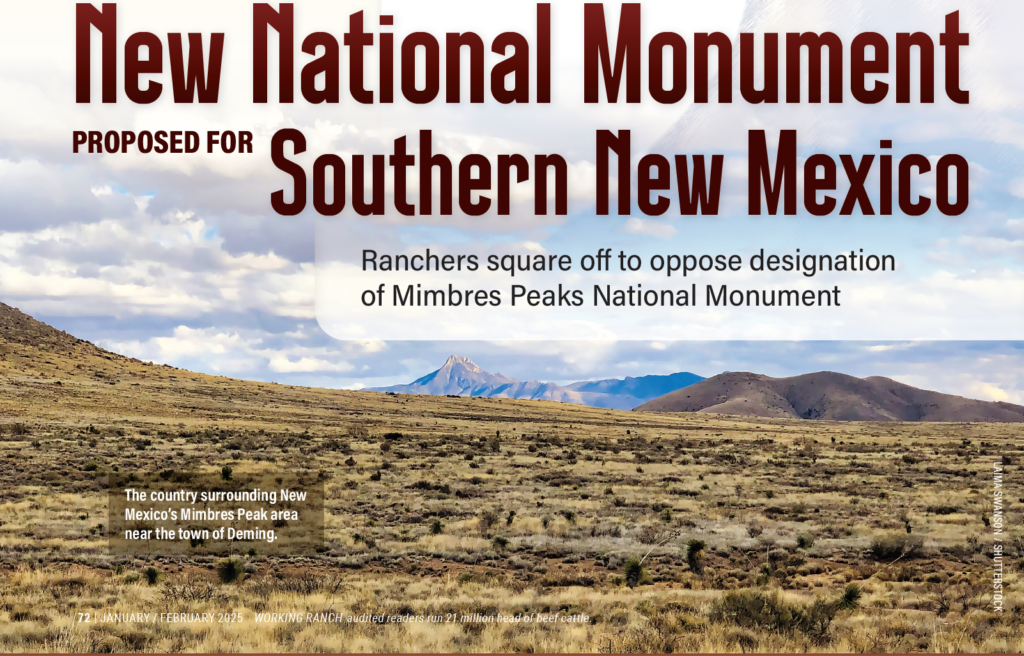
In contrast, the present-day fight over establishing the Mimbres Peaks National Monument is a war of words and agendas. It’s centered just up the road in Deming, New Mexico, and even farther east in Las Cruces.

On one side are the ranchers and others who oppose establishing yet another national monument along the U.S.-Mexico border. On the other side is a coalition of environmental groups that favor protecting the natural and cultural resources encompassed within the proposed borders.

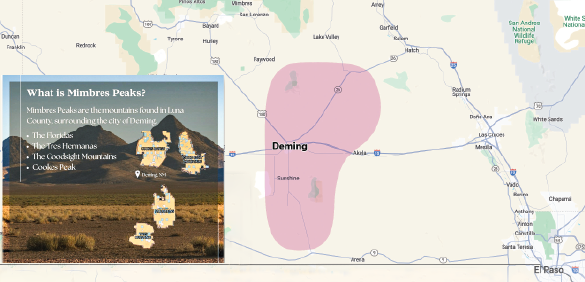
And the proposed area is significant — somewhere around 245,000 acres, roughly 383 square miles.

BACKGROUND

The land within the proposed monument boundaries is a patchwork of federal land under the purview of the Bureau of Land Management (BLM), state-owned property, and ranches that operate both on deeded land and grazing allotments leased from the state and BLM. There are four mountain ranges within the proposed boundary.

New Mexico is home to a handful of National Parks and National Monuments. The two closest to the proposed Mimbres Peaks National Monument are the Organ Mountains- Desert Peak National Monument near Las Cruces and the Gila Cliff Dwellings near Silver City. The effort to put the wheels in motion to declare a new national monument began with a news conference in December 2023.
WHAT THE PROPONENTS SAY

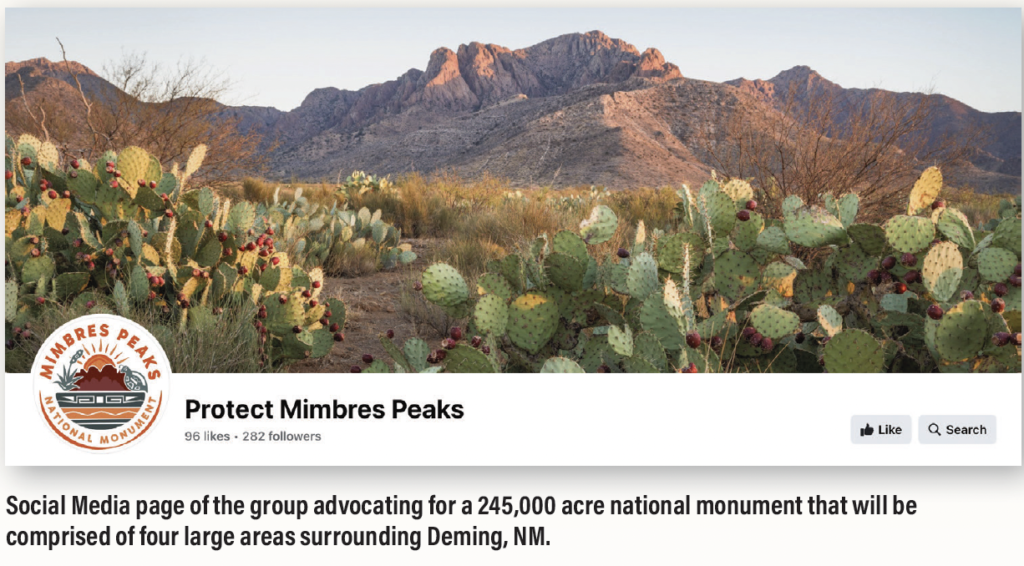
The coalition behind the effort to create the Mimbres Peaks National Monument is called Protect Mimbres Peaks. Organizations involved in the coalition, according to its website, are the Sierra Club, NM Café, Friends of the Floridas, The Semilla Project, New Mexico Wildlife Federation, Outdoor New Mexico, Friends of the Organ Mountains-Desert Peaks, Las Cruces Green Chamber of Commerce, and New Mexico Wild. Listed as supporters are the Conservation Lands Foundation, The Wilderness Society, and the Native Lands Institute.

“For the coalition as a whole, there are various cultural resources, a lot of biodiversity, as well as there’s a lot of historic war items that we would like to see preserved for future generations, as well as many benefits that come with those protections, such as having more field staff with the BLM, such as having a local ranger, outdoor recreation planner, biologist and manager,” said Antoinette Reyes, Southern New Mexico and El Paso organizer for the Rio Grande Chapter of the Sierra Club.

There are different types of monuments, managed by various federal agencies. “This one, because it’s already BLM land, stays as BLM, where BLM prioritizes diverse and multiple uses. So, having some of these staff people is important, and also the type of land designation puts the land in a higher place when it comes to federal funding,” Reyes said.

Then there’s the land itself. “As a state, we have the second most native mammal species, we have the fourth most plant diversity in the country, as well as having along the border area, a lot of migratory paths, especially for birds and some small to medium and a few large mammals as well,” she said, speaking on behalf of the Rio Grande Chapter of the Sierra Club rather than the Protect Mimbres Peaks coalition. “And so, since there are already two other monuments not too far away, this would essentially be one of the first monument corridors in the country, which would bring even more tourism.”
Increased tourism is among the benefits touted as a reason to designate the new monument. Citing the Organ Mountain-Desert Peaks, which has been a national monument for around 10 years, Reyes said there has been a 300% increase in visitation, using counters at the visitor center and cell phone data to record visits. According to an economic study conducted by BBC Research and Consulting and released by the Las Cruces Green Chamber of Commerce, “New non-local visitors to the national monument would directly spend about $10.2 million per year under the medium visitation scenario ($7.3 and $13.1 million, respectively, under the low and high visitation scenarios) per year on goods and services, creating 88 new jobs under the medium visitation scenario (64 to 113 new jobs, respectively, under the low and high visitation scenarios) in tourism and recreation- facing sectors like accommodations, food service, and retail sales.”

When it comes to ranching, Reyes points to the Organ Mountain-Desert Peaks. “So, as an example, for the Organ Mountains in terms of ranching, it stayed the same for how many acres and land they have for it. I know that the number of permittees that have applied has increased since it became a monument. But even with or without the increase, the number of available land has stayed the same in all of their alternatives,” she said.

The alternatives come from BLM’s recently released management plan for the Organ Mountain-Desert Peaks. “The only other area that’s multi-use that’s negatively impacted is mining.” That applies to new mining claims. Existing claims would be grandfathered in, she said. “But aside from that, all other uses stay the same.”

On private land that would fall within the proposed boundary, she said ranchers could make improvements on their own property and roads. “But sometimes there is more red tape to expand a road, or to make more lanes, and stuff like that.”

Reyes said she understands ranchers’ concerns and there have been a lot of good questions. “I know that since it’s so early in the process, they haven’t been able to get all the answers they would like, but there’s been a continuing dialog. I would just stress… the boundaries aren’t completely fixed. It’s still so early in the process that people have even considered changing the boundaries to preserve mining since rockhounding is such an important thing in the community.”

According to Reyes, the timeline for establishing the Mimbres Peaks National Monument isn’t clear. “Most national monuments that have been proposed have, on average, taken five-plus years.”

WHAT THE OPPONENTS SAY

“From the get-go of it, we caught wind just through the rumor mill that this proposed monument was being talked about and there was going to be some kind of press (conference) deal,” said Russell Johnson, a fourth-generation rancher in the area. “None of the ranchers that would be impacted by this monument were invited to it. We reached out to our state senator and state representative. None of them knew about it.”

Johnson serves on the state board for the New Mexico Farm and Livestock Bureau and is president of the Luna County Farm Bureau. Luna County is where the proposed national monument will be located. “None of them knew about it.”

Since then, there have been a few meetings to discuss the proposed monument. “There were several county commission meetings that discussed this and several City Hall meetings that discussed it. The city and the county, the City of Deming and Luna County, all passed resolutions opposing this. And then, the only other municipality within Luna County is the Village of Columbus. They also passed a resolution to oppose this.”

Beyond that, he said several counties scattered across the state have joined Luna County in opposing the Mimbres Peaks National Monument. They are Hildago County, Lee County, Otero County, Union County, Sierra County, and Chaves County.

“We started a grassroots movement through the Luna County Farm and Livestock Bureau called No Mimbres Monument. And we’ve got a Facebook page and a website. And the proponents, they’ve got a Facebook page and a website and that’s pretty much the only way that they’ve engaged the public on the matter, is just through social media.”

The concern by ranchers is the proponents have not engaged the community and the stakeholders who will be impacted, he said. For some ranches, the entire operation is within the proposed boundary. “And then, in our case, about half of our ranch is within the monument.”

Johnson said that proponents point to the Organ Mountains-Desert Peak National Monument as an example of how grazing hasn’t been impacted. “My argument there is, even though it’s been designated for over 10 years… they still haven’t developed a resource management plan for that monument.”

The resource management plan dictates how resources will be managed within the monument. “That’s where you’re going to start seeing the effects on landowners, and particularly stakeholders like ranchers. Because (that’s where) you really get into the guts of the rules and regulations of a monument,” he said.

That’s another point of concern. “We went to one of the meetings (about developing the resource management plan for the Organ Mountains-Desert Peak National Monument) and they told us usually these resource management plans take years to develop, which we’re already in year 10, but it seems like up until recently, they finally got serious about developing a resource management plan, but they’re trying to fast-track it and get something in place by the end of the year. And even the BLM was telling us that’s kind of not the norm.”

Then, of course, there’s the concern about being able to continue grazing cattle on federal land within the proposed monument. Johnson points to the Sonoran Desert National Monument in Arizona where he said that the grazing leases on the southern portion of the monument didn’t renew. “And then, to date on the northern portion where there’s still grazing, (environmental groups) have brought two or three lawsuits against the BLM basically to try to get the BLM to eliminate grazing on the remainder of the monument. So that’s a concern to us. Will our leases be renewed? Will grazing be eliminated right off the bat?”

He gives a nod to statements by the proponents that grazing will remain the same. “But our issue is, you can eliminate grazing from the landscape without saying that you’re going to eliminate grazing. And by that, I mean if you start changing the way we can manage this land in the sense of maintaining improvements with equipment versus doing it by hand or not being able to install new improvements. If a well goes dry, are we going to be able to get equipment in there to drill a new well, things of that nature?”

In Johnson’s mind, establishing the Mimbres Peaks National Monument doesn’t make sense. “The BLM’s already managing it anyway. And I look at it as we’ve got a pretty good working relationship with the federal government through BLM and we’re doing a pretty good job of managing these lands as it is. And there’s really no advantage to designating it a national monument.”

FOR MORE INFORMATION

Protect Mimbres Peaks: www.protectmimbrespeaks.org

No Mimbres Monument: www.nomimbresmonument.org

Organ Mountains-Desert Peak resource management plan: https://eplanning.blm.gov/public_projects/92170/200212669/20107574/251007574/OrganMountains-DesertPeaks%20Natl%20Monument_DEIS%20RMP_20240404_508.pdf

Economic Analysis: https://protectmimbrespeaks.org/wp-content/uploads/2023/12/MPNM-Economic-Impact-Report-Nov-29-2023-FINAL-V2.pdf

Tags: , , , , , , ,

Stop the bleeding from Colorado’s wolf disaster

Dr. Duray’s column paints Colorado’s wolf reintroduction as a poorly managed, ethically flawed program causing avoidable livestock losses and financial strain on taxpayers. He strongly advocates for Initiative 13, which would legally end the importation of wolves and impose stricter oversight—argued as necessary to correct CPW’s failures and restore public confidence.

Here’s a breakdown of the guest opinion “Stop the bleeding from Colorado’s wolf disaster” (Western Livestock Journal, Jun 26, 2025):

🐺 Key Points from the Author, Dr. Chuck Duray

  • Argues that Colorado’s wolf reintroduction has become a “man‑made disaster,” with only 8 survivors out of the initial 25 wolves (32% survival) en.wikipedia.org+2wlj.net+2wlj.net+2.
  • Says Colorado Parks & Wildlife (CPW) is treating wolf reintroduction as an “ongoing experiment” rather than responsible wildlife management, ignoring ethical and legal concerns wlj.net.
  • Highlights significant livestock losses attributed to wolves, including direct kills and stress-induced issues like pregnancy losses wlj.net+1en.wikipedia.org+1.

Criticism of CPW & Support for Initiative 13

  • CPW allegedly violated its own protocols by relocating chronically depredating wolves, leading to “Memorial Day massacres” at three Pitkin County ranches wlj.net+3wlj.net+3en.wikipedia.org+3.
  • The author argues that CPW ignored warnings against translocation and lost public trust .
  • Initiative 13 seeks to halt further wolf importations and reintroductions, legally preventing CPW and the Department of Natural Resources from continuing what the author views as reckless management wlj.net.

Broader Implications & Stakeholder Critique

  • The author criticizes ranchers’ associations for being “short‑sighted,” lacking effective engagement with Gen Z/millennials urban voters who supported 2020’s Proposition 114 wlj.net.
  • Compares CPW’s ongoing compensation to Colorado taxpayers to the inefficiencies of “Cash for Clunkers,” noting compensation claims are 153% over budget wlj.net.
  • Concludes that supporting Initiative 13 is the only way to stop what he calls an ideological, government‑driven wolf experiment, restore trust, and protect both livestock interests and taxpayers

Memo to Egypt Valley Wildlife Refuge committee:

When Biden bought 24 million acres of open land from private owners
few cared. Now when Trump wants to sell 3 million acres, the way
this article is written you would think they were auctioning to the
quickest bidder Niagara Falls, Old Faithful and Pikes Peak. The twist
of militant environmentalists is extremely sad and humorously comical.
The ever expanding national debt could be blasted down with funds
from federal, state, county wasted “public lands.” 

Republicans who check it out know this is the right thing to do–sell
90% of “public lands.”  Pay the national debt. And, to embellish the
twist, “mass sell-off” equals only 0.46% of federal land holdings. D


https://dailycaller.com/2025/06/18/benji-backer-mass-sell-off-public-lands-bad-america/

30×30 Conservation Welfare Programs Remain in the “One Big Beautiful Bill Act”

While the House bill makes significant cuts to the green new deal agenda, including eliminating pro carbon sequestration pipeline language, the final bill failed to cut one of the key 30×30 programs authorized in the Inflation Reduction Act. $10,050,000,000 remain authorized for conservation welfare programs that commit private lands to mitigating the climate crisis.

American Stewards exposed the slick way in which environmentalists managed to authorize trillions of dollars for existing conservation programs through the Inflation Reduction Act (IRA) by adding funds to the Environmental Quality Incentives Program (EQIP), the Conservation Stewardship Program (CSP), the Agriculture Conservation Easement Program (ACEP) and the Regional Conservation Partnership Program (RCPP). These existing programs are funded through the Farm Bill.  But the IRA added trillions of dollars to these, and also changed the purpose for these funds now obligating private landowners who enrolled to mitigate climate change and reduce livestock emissions.

Most landowners had no idea the legal purpose for the funds had been changed, and the Biden USDA failed to inform landowners of this switch. This was deliberate so they could create a federal nexus to private lands obligating the use of these lands to mitigating the made up climate crisis.

But free money is hard to pass up, so instead of protecting property rights, lobbyists for big Ag have been working hard to preserve these “climate smart” funds, which they say is necessary for farmers to put food on American’s tables. 

They succeeded in preserving those remaining funds for EQIP, CSP and ACEP for a total of $10,050,000,000 through 2026. 

The House did reduce the funds obligated to the RCPP program, which directly funds environmental organizations implementing the green new deal.  These funds have been reduced from $3,050,000,000 for 2026 to $425,000,000 for 2026, but then also authorizes $450,000,000 annually through 2031.

These are conservation welfare subsidies. They are not necessary for agriculture production. They drive up land and food prices and drive out the small landowners who want to stay in business without relying on federal welfare. They also tie every landowner who enrolls in this pot of funds to mitigate the climate crisis.  It creates a dangerous federal nexus to their land, likely to be called in during the next democratic administration.

The Federal Plan to Monetize Sunlight, Bee Pollination, and Photosynthesis on Your Land

https://www.theepochtimes.com/epochtv/the-federal-plan-to-monetize-sunlight-bee-pollination-and-photosynthesis-on-your-land-facts-matter-5787722?utm_source=Goodevening&src_src=Goodevening&utm_campaign=gv-2025-01-08&src_cmp=gv-2025-01-08&utm_medium=email&est=AAAAAAAAAAAAAAAAZeM5eh8z2c

On a previous episode, we went into some great depth exposing the 30 by 30 agenda. Also known as the “America the Beautiful” program, it was a plan to place 30 percent of America’s land under conservation by the year 2030—essentially locking up a lot of America’s real estate for ostensibly environmental reasons.

One avenue through which the federal government was attempting to do this was to have the Securities and Exchange Commission (SEC) create an entirely new class of assets called natural asset companies.

This move would have created a new class of company that would then allow investors to purchase the rights to millions of acres of public federal lands, as well as private lands under easement contracts.

Essentially, it would have turned much of the natural resources (such as air, sunlight, and photosynthesis) on America’s land into a tradable stock, open to all investors—including our geopolitical adversaries.

Furthermore, the creation of these “natural asset companies” would have effectively locked up these lands, making it illegal for any entity to conduct any type of financially motivated activity on those lands—such as mining, drilling, farming, ranching, grazing, hunting, fishing, harvesting timber, and so on.

It would essentially take American land out of useful economic production.

And the cherry on top of all of this was the fact that the SEC’s planned rule change seemed to go under the radar—with very little fanfare and with a very short public comment period.

However, it was Margaret Byfield and her organization, the American Stewards of Liberty, who spearheaded the effort to kill this rule before it went into effect.

But while the SEC rule was canned, the idea of locking up U.S. land has morphed into something called “natural capital accounts,” which are now being created to quantify nature’s value and list those values as new assets of the federal government.

We had a chance to sit down and speak with Byfield about what this all means for the average U.S. citizen, as well as her efforts to fight back against what she calls encroachments on our liberty.

Join host Roman Balmakov on this week’s episode of “Facts Matter.”

Views expressed in this video are opinions of the host and guests and do not necessarily reflect the views of The Epoch Times.

Utah Fights for Control of Federal Lands

In 2024, Utah filed a lawsuit challenging the federal government’s control over 18.5 million acres of “unappropriated” land—areas without specific congressional designations like national parks or forests. The state contends that the indefinite federal retention of these lands is unconstitutional, arguing that the Property Clause of the U.S. Constitution grants Congress the power to “dispose of” federal lands, not to hold them without designated use.

Utah Attorney General Sean Reyes emphasizes that federal control over nearly 70% of Utah’s land limits the state’s sovereignty and self-governance. The lawsuit also challenges the Bureau of Land Management’s (BLM) recent Public Lands Rule, which elevates conservation to a status equal with grazing and mineral development. Utah argues this shift contradicts the BLM’s legal obligation to promote multiple-use and sustained yield under the Federal Land Policy and Management Act (FLPMA).

The case has garnered support from various states, counties, and organizations, all urging the Supreme Court to hear it. Critics of federal land retention assert that it infringes on state sovereignty and hampers economic activities such as grazing, energy production, and recreation. They also claim that policies mandating indefinite federal land retention treat states like Utah unequally compared to those with greater control over their lands.

This legal challenge underscores ongoing tensions between state and federal authorities over land management in the Western United States, with significant implications for public land policy and state sovereignty.

Full Article here: https://americanstewards.us/utah-fights-for-control-of-federal-lands/

The State of Utah has a website called Stand for our Land at https://standforourland.utah.gov/

Tags: , , , , , ,

Federal Agencies Using Tricky Accounting to Grab More Power

The Epoch Times sits down to speak with Aurelia Skipwith, the former director of the US Fish and Wildlife Service under President Trump.

And she explained to us her insights regarding the Biden Administration’s Agenda 30×30, (to place 30% of America’s land into conservation by the year 2030) and how ultimately, it’s all a giant government power grab under the guise of environmental policy.

https://www.theepochtimes.com/epochtv/federal-agencies-using-tricky-accounting-to-grab-more-power-facts-matter-5522671

The Renaissance Cowboy

Author: LEE PITTS

Darol Dickinson is the cattle industry’s Renaissance Man. As you’re probably aware, The Renaissance was a period in European civilization that was marked by a revival of Classical learning and wisdom. To refer to someone as a “Renaissance Man” or “Renaissance Woman” means that individual is extremely intelligent and a highly skilled person in many areas.

I don’t know of a better definition of Darol Dickinson than that.

Head To Tail

I first became aware of Darol when a friend gave me Darol’s classic book called ‘The Color of Horses’ in which he’d illustrated all 36 of the paintings in it. To this day I haven’t seen anyone who can paint a horse better than Darol did. When the Cowboy Artists of America (CAA) opened at the National Cowboy Hall of Fame in 1966, Darol had artwork in the show as a member of the prestigious CAA. My friend Heather Thomas Smith wrote the best biographical sketch I’ve read yet about the colorful Dickinson and quoted him as saying, “I did paintings and portraits and sold drawings when I was a teenager, selling them from $2 to $5. By the time I went to college I’d sold enough paintings that I was able to just go in and sign up. I asked how much it cost, and wrote them a check.” He was painting portraits of people’s horses and herd bulls all during his college years.

Every time Darol sold a painting he used the money to buy Texas Longhorns or land. By 1979 he quit the painting, constant traveling and taking livestock photographs, (in which he also excelled), to concentrate on his Longhorn business in Colorado. It didn’t take him long to become the leading Longhorn breeder in this, or any other country.

In 1993, Darol relocated his operation to the grasslands of eastern Ohio. He registers more than 500 Longhorns, African Watusi’s and Dutch BueLingo cattle every year and the ranch sells 500 cattle per year, two-thirds of which are registered breeding stock. The rest are sold as processed beef through the Dickinson Ranch store called Head to Tail.

To give you an idea of what an entrepreneur Darol is, consider that when some horns of his beloved Longhorns got broken Darol developed a squeeze chute with open horizontal bars and has never had any cattle get hurt in it. To this day Darol’s ‘Bry Squeeze’ is one of the leading cattle squeeze chutes of any kind.

Says Darol. “We had to create some different markets, and do things different. It worked with a breed of cattle that nobody else wanted, and it became great. It was the trail less traveled.

Land Grabs

Darol has also written several books including Horn Stew, Fillet of Horn and his latest, Larapin Horn, but it is his most recent essay, Land Wars of the World, that should be read by every one in America.
https://downsize-government.org/government-overreach/land-wars-of-the-world-then-and-now/

Land Wars Of The World deals with many of the biggest land grabs in history. Wrote Darol, “Since Adam and Eve, land wars seem to have been part of history. From the earliest battles in ancient Mesopotamia to today’s wars in the Middle East, conflicts over land have continually shaped our world.” According to Darol, “Most wars have been about taking tribute from conquered subjects and land grabs for the powerful. These land grabs are usually paid for by the losers.”

“Alexander the Great lived more than 2,000 years ago,” wrote Darol. “By age 30, he had amassed one of the largest empires in history, stretching from Greece to northwestern India. Widely considered one of world’s most successful military commanders, he was undefeated in his battles for land and tribute.”

“The Roman Empire was one of the largest land grabs in history,” wrote Darol, “with contiguous territories throughout Europe, North Africa, and the Middle East. The Latin phrase “imperium sine fine” (empire without end) signaled! That neither time nor space limited the Roman Empire’s expansion. The basis of Rome’s strength, like Alexander’s, was land capture and tribute.”

More recently we’ve seen the downfall of the Commonwealth of Great Britain which was arguably, the most powerful nation in the world at the time before losing its conquered lands one by one. More recently we’ve witnessed Putin’s attempted land grab in Ukraine.

He’s No Abe Lincoln

In reading Darol’s essay I realized there was another reason Abraham Lincoln is my favorite president. Darol writes, “The 16th President of the USA, believed that private ownership and management of land is more productive than government control. He understood that the Federal government couldn’t possibly manage the whole western USA. Private property was the answer, land surveyed, titled, used, improved, maintained, and loved by non-government owners. At the peak of the American Civil War, Lincoln developed a strategy to increase the US’s citizen-owned land. He signed the 1862 Homestead Act into law. It was intended to open western lands to settlers on what the government considered to be ‘idle’ tracts of land captured from Native Americans or purchased like Alaska and the Louisiana Purchase. Pioneer homesteaders were required to improve the land and produce goods, food, or a service. If they lived on their 160-acre homesteads for seven years, the land was theirs at no cost.”

Compare that attitude with President Joe Biden who on January 4, 2024, in Coconino County, Arizona, “Proudly announced,” wrote Darol, “his administration had so far wrested a whopping 24 million acres from private enterprise for the Federal government — a new record for land takeovers, paid for with public tax dollars, and now eliminated from private management and production. Why this enormous acquisition? Ostensible reasons include ‘preservation,’ ‘conservation,’ ‘protection,’ and so forth. To encourage citizens to believe that these and other millions of acres are still theirs, the government often renames formerly private property as ‘public’ land.

The question bounces back, however: “Who is all this land being protected from?”

An Out of Control Monster

Darol rounded up some numbers that should concern everyone. Darol found that the US government owns 664,000,000 acres — almost 30 percent of the nation’s total continental land mass of 2,271,343,000 acres. Darol also found that the national debt is $34,000,000,000,000. That’s 34 Trillion! Darol then calculated the US debt per acre of US owned collateral and found it to be $51,203 PER ACRE! Good luck trying to find a banker who’d give you a loan on that basis!

In other words, “The feds own more ground than the entire acreage of the Roman Empire, give or take a few coliseums.” Writes Darol, “Most Americans don’t realize that our government’s undeclared war for land is a covert, out-of-control monster.”

“How did the federales remove so much land from private tax rolls? Well, they funded it with public tax dollars. The takeover is orchestrated not by Congressional legislation but by executive orders from the Oval Office and rulings from the administrative bureaucracy — without a vote of the citizens or their representatives. The unstated process of this unacknowledged land grab typically bypasses public scrutiny.” Agencies in the Executive branch in Washington, D.C., issue rulings, levy fees and fines, collect “tribute,” then buy private property and remove it from production. That bureaucratic removal is a political conquest that marks the end of private management. The process has historically happened in war but continues today under political cover.

“As recently as January 2024, President Biden also announced that he was expanding the Green movement in Alaska by closing 10,600,000 acres to oil and gas leasing. The federales already own 95.8 percent of Alaska, leaving only 4.2 percent of a resource-rich state for private enterprise to manage and harvest. This administrative action now ‘protects’ the nation’s western Arctic area from the alleged detriment of oil and gas exploration.”

“That’s not the only conquest of private property orchestrated from D.C.,” wrote Darol. “On his inauguration day, Biden mentioned his 30×30 Plan — a strategy ( or plot or scheme) to transfer 30 percent of US land from private ownership to the government by the year 2030. He later released his 50×50 Plan for the government to transform 50 percent of the US to ‘public lands’ by 2050. And believe it or not, Biden has even proposed a 70×70 plan, that would put 70 percent of America under direct government ownership in less than 70 years.

In an Epoch Times interview, Aurelia Skipworth (President Trump’s Secretary of Fish and Wildlife) said, “No one knows how much land the Federal government thinks is enough.” Margaret Byfield, Executive Director of American Stewards of Liberty said, “This is their end game. The reason for the 30×30 land grab. The purpose for the climate crisis hysteria. We will own nothing. The US government will own everything.”

“The Federal government, (not including State lands) already owns 87.8 percent of Nevada, 75.2 percent of Utah, 70.4 percent of Idaho, 60.4 percent of Oregon, etc. As noted above, it already owns nearly 30 percent of continental US land, so it has almost achieved the full 30×30 goal of Federal ownership. As the 50×50 proposal clearly shows, more acquisitions of private land are being planned for the ‘public good,”’ wrote Darol.

Closer To Home

“You may not be concerned with yesterday’s land-grabs by Attila the Hun, or perhaps today’s by Vladimir Putin in Crimea and Ukraine, or maybe not even current marginal US lands a thousand miles away. But what about tomorrow, on your own doorstep?” asks Darol rhetorically. “What if a property is right across the road from your home? What if some State or Federal agency claims it is fallow ground better used for conservation or wetlands or biodiversity or ‘the greater good’? You could become the victim of peacetime ‘tribute.”’

“Such is the case of Kirkwood Township in Ohio s Belmont County,” says Darol. “Only 4.2 percent of Ohio is owned by the Federal government, yet the State itself owns 664,000 acres. Heres the hidden hitch: governments at all levels work together in a fungible relationship. Historically, they have traded land among themselves to fund bridges, city water development, etc. Never have these fungible transactions been determined by a vote of the citizens — never! So we must ask, ‘Are the Federal and Ohio governments working together on Biden s 50×50 scheme in Belmont County?’”

“In Kirkwood Township, a citizens committee has identified the effects of Big Brother as a neighbor and they aren’t good. Under the Ohio Department of Natural Resources (ODNR), the State of Ohio has acquired up to 28,000 acres in Belmont County for the Egypt Valley Wildlife Refuge. It’s working to confiscate more. This land is a small fraction of the land that Ohio already owns, but the committee has discovered that the State’s piece-by-piece ‘conquest’ is devastating the local economy. An undeclared war on private land has made Kirkwood Township the poorest in Belmont County and one of the poorest municipalities in Ohio.”

On Our Watch

‘Why this dereliction?” asks Darol. “Broken promises are the reason that the Egypt Valley Wildlife Refuge has degenerated from its idealistic origins to its present wretched condition.

Over two dozen years ago, the ODNR rationalized its take-over of 28,000-acres. It promised to help the local economy by developing tourism through lakes, pavilions, trails, hunting, fishing, etc. To date, however, the 100-acre lake has not materialized — nor have any of the other improvements. As with so much government fallow land, the EVWR is now an impenetrable jungle spotted with litter and heaps of trash. Why the unfulfilled promises? This public land is suffering from a lack of routine, responsible management.”

In the meantime …

  1. The Ohio Department of Natural Resources (ODNR) pays zero taxes. The tax loss from the EVWR is estimated at $8,932,000 during ODNR control. This lost revenue could have gone to roads, schools, law enforcement, and public services.
  2. No timber has been select cut. It could have been responsibly, sustainably cut every 18 years. 28,000 acres x $2,000/acre x 2 cuts = $96,000,000 of lost income.
  3. No agriculture or hunting leases have been issued. 28,000 acres x $30/acre x 28 years=$24,360,000 forfeited — not a cent received by local governments.
  4. No oil and gas signing leases. $5,000/acre =$140,000,000 unrealized.
  5. No oil and gas royalties. 18 – 20 percent annually for 35 years. Incalculable losses.
  6. No surface liquidation. $2,000/acre x 28,000 acres = $56,000,000 potential income.
  7. Undeterminable loss of private enterprise production of food, products, and services.

    “To repeat, due to negligent and non-existent government management, none of the above has been accomplished in Belmont County, Ohio. This pathetic record, “ says Darol, “is typical of most Federal lands. The government simply does not exercise the care and concern of private enterprise.”

    What can an individual do at this late date to save America from the Socialists? Darol has a short list of answers. “Elect representatives who pledge to never expand government land or who will vote to preserve land under only the most compelling conditions; Support representatives who pledge to sell government properties back to private owners in a systematic, orderly process for profitable use; Demand taxation of all government properties and vehicles; Be alert to well-meaning bureaucrats who are actually scrambling to earn Biden’s approval by confiscating millions of acres of private property.

    “Quit this taxpayer-torture!” says Darol. “The bleeding must stop. Just say no to all new government land acquisitions and start an orderly liquidation of the government wasteland ownership.”

    As a student of history Darol says, “All great nations eventually die out, some more slowly than others.”

    It is not hyperbole to suggest that this upcoming election will decide if your grandchildren grow up in a capitalistic Democracy and enjoy the same freedoms and liberties we have. We should NEVER let it be said that America the Beautiful died on our watch.

    • • • • • • • • • • • • • • • • • • • • • • • • • •
    Original Article can be found here:
    https://issuu.com/nmstockman/docs/lmd_april_24

    CCA sues to stop elk fence removal

    Control Food